
Friday, November 9, 2018
An Automated Search for Transiting Exocomets- HD 182952 (KIC 8027456)

Saturday, August 26, 2017
Likely Transiting Exocomets Detected by Kepler by Visual Lightcurve Inspection

KIC 3542116

https://arxiv.org/abs/1708.06069
In January 2017, amateur astronomer Tom Jacobs proposed the idea of visually surveying the complete Q1-Q17 Kepler lightcurve archive spanning 201,250 target stars for Data Release 25 (Thompson et al. 2016) with professional astronomers Saul Rappaport and Andrew Vanderburg along with amateur astronomer Daryll LaCourse. "The survey was conducted using the LcTools software system (Kipping et al. 2015), a publicly available Windows-based set of applications designed for processing lightcurves in a fast and efficient manner. Two primary components from the system were utilized; LcGenerator for building lightcurves in bulk and LcViewer for visually inspecting plots of the lightcurve for signals of interest." Tom Jacobs coordinated with citizen scientist Al Schmitt, author of LcTools, in generating the Kepler prime- field lightcurves in batches of ten thousand.
The team has worked on similar projects with the K2 campaigns. The survey lasted five months with one person (TJ) individually inspecting each lightcurve for interesting objects that were non periodic in nature. There were no predetermined search parameters. Everything was on the table and numerous flagged objects turned out to be data breaks and data processing anomalies (data glitches) upon subsequent analysis by Saul Rappaport and Andrew Vanderburg. Both veterans were indefatigable in supporting the search effort. On March 18th, KIC 35421116 was initially flagged for its three aperiodic transits and subsequently labeled and analyzed as exocomet candidates.

Initially, there was a lot of back and forth discussions on just what the three events were. Concern about data processing anomalies, stellar variability, star dimming (photometric variability), cosmic ray hits (SPSD) and contamination by the neighboring star KIC 3542117 had to be addressed. These concerns were examined in detail and later ruled out as more astronomers, with the specialized expertise, joined the team. Saul Rappaport independently narrowed the possibilities of event type to exocomets due to the asymmetric shapes, shallow depths and lack of clear periodicity. Jon Jenkins successfully advocated for three smaller events in the lightcurve that were eventually considered by the team to be exocomet transits with a possible stellar variability caveat due to their shallow depths and low signal to noise ratio.
Knowing that exocomet-like targets exist in the Kepler data, a second exocomet candidate was flagged in the lightcurve of KIC 11084727 on May 1st, though similar lightcurve profiles would not have been missed during the survey. Attaching an exocomet label to the event proved to be very exciting.

Without the visual survey it is highly unlikely that these two stars would have been flagged even though exhaustive algorithm machine surveys have scoured through the Kepler prime-field data looking for transits over the years. Viewing comet transits in the Kepler data was not thought possible until now and they appear to be rare events likely due to instrument sensitivity and orbit profile viewed by Kepler:
"With regard to the number of comets that should be seen crossing the disk of the host star, this rate should depend heavily on whether the infalling comet orbits are distributed roughly isotropically (lower rate) or if the reservoir of bodies producing the dusty tails has orbits that are coplanar with the angular momentum vector of the system (higher rate if the observer lies in this plane)."
"Present technology does not enable us to view images of these kilometer-size infalling bodies" SETI Institute talk, "Exocomets: Now you see them, now you don't" by Dr. Barry Welsh January 23, 2017.
To date: "Radio observations, in particular detections of circumstellar CO emission around stars such as HD 181327 (Marino et al. 2016), Eta Corvi (Marino et al. 2017), and Fomalhaut (Matra et al. 2017) have been attributed to the presence of substantial populations of minor bodies at large orbital separations. Another sensitive method for detecting and understanding populations of extrasolar minor planets is through time-series spectroscopy, rather than time-series photometry (e.g., as performed by Kepler)."
Exocomet candidates are then said to have been observed indirectly:"Growing evidence for the existence of large populations of extrasolar minor bodies orbiting other stars has come from the detection of anomalous absorption features in the spectra of at least 16 A-type stars where Falling Evaporating Bodies (`FEBs') are proposed to randomly cross the observing line of sight (e.g., Ferlet et al. 1987; Beust et al. 1990; Welsh & Montgomery 2015)."
According to Barry Welsh, "a spectrographic study would clinch their case (Kepler) for comets or show they found rocks and dust" (Wonky Signals from distant stars could be signs of exocomets by Jesse Emspak). What we are now seeing is a possible synergistic blending of observation modalities for validating comets outside our solar system. The upcoming TESS mission may provide more opportunities to observe exocomets and expand our knowledge of these early pristine objects of solar system evolution.
A paper written by a French team in 1999, "Photometric Stellar Variation due to Extra-solar Comets" predicted the detection of exocomets by their dusty tails ( A. Lecavelier des Etangs, A. Vidal-Madjar, and R. Ferlet 1999).
"We performed detailed numerical simulations of stars’ occultations by extra-solar comets. We extracted the apparent photometric variations of the central stars due to these putative comets. We have shown that: 1) Extra-solar comets can be detected through photometric variations due to occultation by dusty tails. In many cases, the light curve shows a very particular “rounded triangular” shape. However, in some remaining cases, the curve can mimic a planetary occultation. 2) The photometric variations due to cometary occultations are mainly achromatic. This property will allow to discriminate the occultations by comets from intrinsic stellar variations. However, the confusion with planetary occultations cannot be efficiently removed by color measurements in the optical. 3) The number of detections which can be expected from a large photometric survey of several tens of thousand of stars at high accuracy (10−4 ) is of the order of several hundreds of occultations per year."
In 2017 we may be seeing their predictions coming true.
Wednesday, January 11, 2017
Resurvey of Kepler Legacy Stars Long and Short Cadence Data

KIC 1028018 LcTools Lightcurve Viewer
Citizen Scientists now have a second chance to survey the Legacy Kepler light curves from their computer den using the free LcTools program by Allan R Schmitt. The light curve resolution is outstanding. This year, using the LcTools generator, the Kepler Long Cadence light curves will be made available as text files in batches of ten thousand stars. Visit Allan R Schmitt's website for the latest release.
Saturday, June 7, 2014
60019950 Possible Planet Transit in Kepler Two-Wheel Engineering Test Data
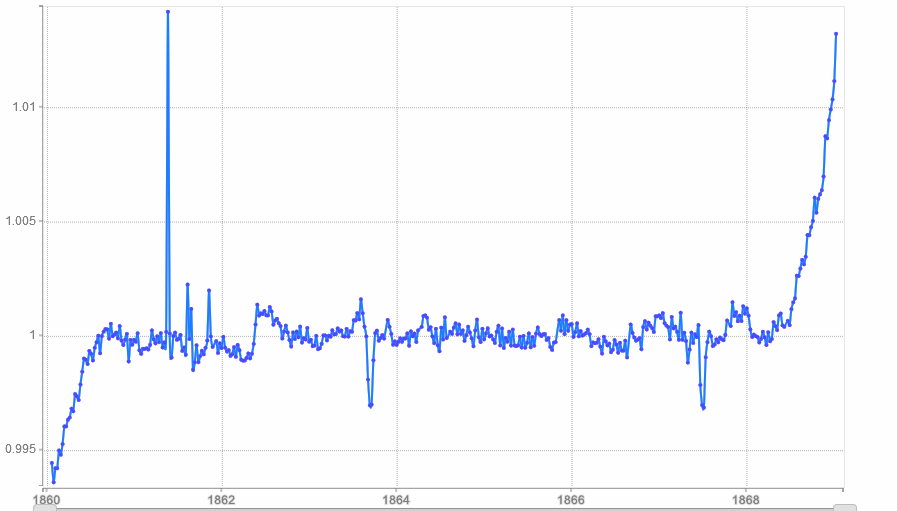
Graph of Light Curve for 60019950 courtesy of Kian Jek
60019950, 354.9707, 1.98333, 14.8, cool_star
Kian Jek processed the data for this star that reveals two transits that may indicate a grazing planet transit.
Daryll LaCourse:
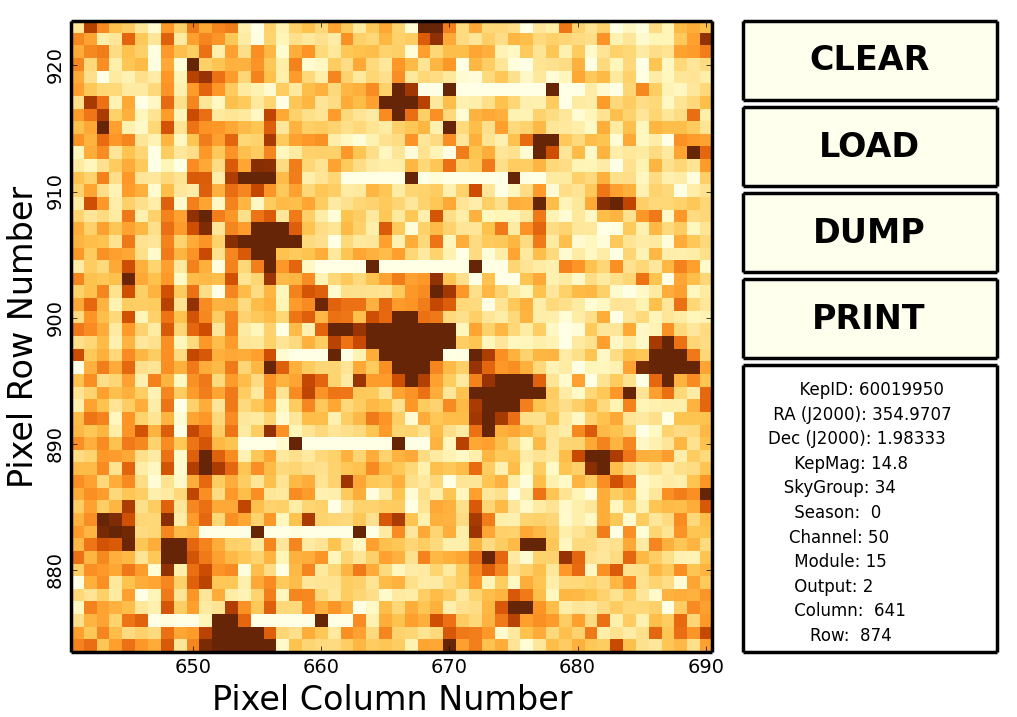
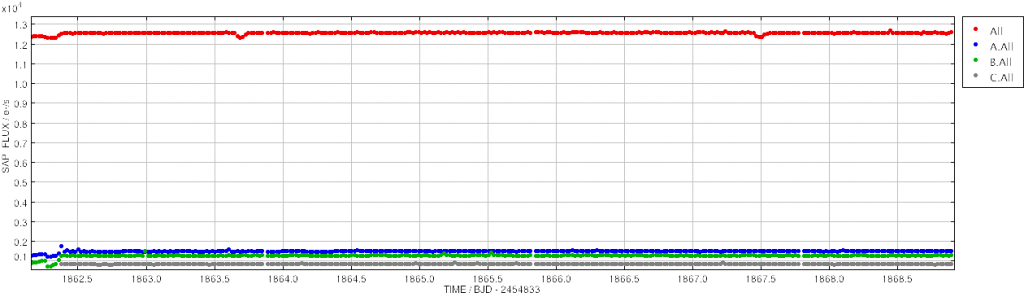
I took a few minutes to pull up the 60019950 field again. I've extracted light curves from the three neighbor sources at roughly 10, 7 and 4: o'clock, and I see no evidence for these transits/eclipses originating from any of those sources:
Daryll LaCourse:
If anyone wants a taste of what sort of light curves Campaign 0 may deliver, the massive TPFs for these engineering test targets arenow available. In order to extract light curves from them you will need to utilize PyKE (via Ureka bundle is probably the best method) or write your own software.
from the Kepler Blog (emphasis added):
TWO-WHEEL ENGINEERING TEST DATA ONLINEMAR 25, 20149 days of two-wheel engineering data have been delivered to the MAST archive and are accessible to all interested users within the community. This data was collected between Feb 4-13, 2014, before Campaign 0, and points to a different region of sky to Campaign 0, RA = 359 deg, Dec = -2 deg. In future publications and presentations, we would be grateful if you referred to these data collectively as the "Two-wheel Concept Engineering Test". The motivation for delivering this test data is described below.
Campaign 0 is currently underway. Data collection began on Mar 10 and is expected to end on May 30. Campaign 0 is a full end-to-end shakedown test of two-wheel operations. The data collected from Campaign 0 will be processed through the existing Kepler pipeline only as far as the production of Target Pixel Files - small, calibrated and time-tagged images for each target. Further processing of the data, potentially through light curve creation, systematic error mitigation, transit searching and transit characterization is pending operational recommendations and financial decisions from the NASA Senior Review process. Therefore, for data collected during Campaign 0 and the first few potential future campaigns, the scientific community will be far more hands-on in the process of constructing the light curves required to deliver their science goals. Some of the approaches for light curve construction from Kepler Target Pixel Files have been incorporated into the existing PyKE software suite - Simple Aperture Photometry, PSF-fitted photometry and pixel-level Principal Component Analysis. While these Kepler tools will work out of the box for Campaign 0 data, users should note well that the larger spacecraft motion during data collection on two-wheels will mean that the best photometry solutions for Kepler will not necessarily be the best solutions in any future two-wheel operation. The community are encouraged to test the current solutions critically and develop alternatives when necessary. The Kepler Science Center will be turning its attention to these problems also, pending Senior Review endorsement, but the benefits of that effort will not be felt until deeper into the proposed mission.
Therefore to help the community in the endeavor of maximizing photometric quality and precision of a two-wheel mission we have delivered engineering data to the MAST archive. The Kepler spacecraft operated with fine-guidance, collecting data from 2,017 target masks. The properties and quality of the data therein is expected to be similar to those collected during Campaign 0 and provide an excellent opportunity for scientists to make an early and impactful start upon their investigations. Note also that the chances of there being undiscovered planet transits in this engineering set are high and the potential for other serendipitous science is great. To this end we have also provided lists of long cadence and short cadence targets with a brief description of why each was observed during the test. For those investigators eager to develop this test data scientifically and those investigators with the enthusiasm to develop new technical solutions for two-wheel photometry, we encourage you to dive wholeheartedly into this data set. The anonymous ftp address for data download is archive.stsci.edu and the data is archived in folder /pub/k2/tpf_eng. Alternatively there is a URL. A typical file size for one of these target pixel files is 26 MB. The Kepler Science Center will not support this engineering data with future reprocessings, deliveries or new products. However the Kepler Science Center will support questions through the helpdesk regarding this data set on a best-effort basis.
Visit Planet Hunters Talk for more information on analyzing the K2 Engineering test data.
Monday, May 5, 2014
KIC 8681125 Possible Unlisted Planet Candidate at Planet Hunters

Kepler Light Curve KIC 8681125 in Q16 at Planet Hunters
Planet Hunters forum Talk member Kugelbitz flagged this light curve in Kepler Quarter 16 that was subsequently analyzed by veteran Talk members as a viable 5.24 RE planet candidate with two known transits in Q10 and Q16.
Kian Jek:
The first new PC seen in a long time - and just goes to show there are still treasures hidden in the data set even almost a year after Kepler has stopped functioning and moved on to its next mission!
The problem with this target is that although it's situated near the center of the FOV, it lies at the extreme edge of the module, and it's only visible in two out of four of the CCD panels or channels. These correspond to the even quarters and so the odd quarter data are missing.
Because of these large data gaps, one can fit two possible periods to this PC, either 615d or 307.5d.
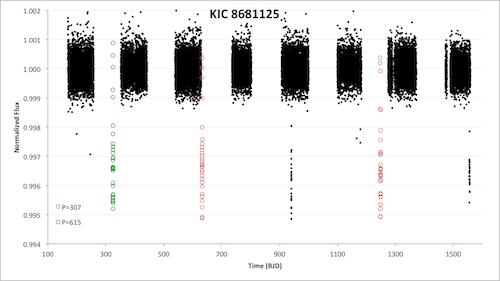
The two visible transits can be model-fitted to a 615d period transit exceptionally well (see the R2 statistic):
The transit can also be fitted to a 307d period, but this gave an anomalous a/R* of 187.7 vs 375; the latter value is more consistent with the stellar radius and orbital separation wrt period, so the 307d period can be ruled out.
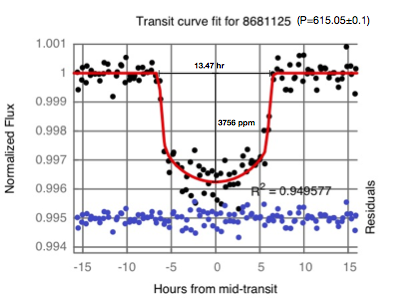
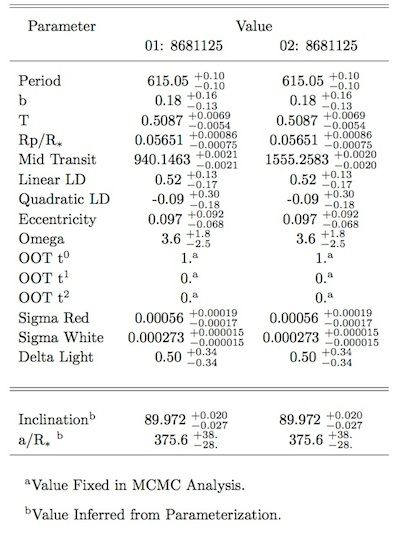
The stellar radius appears to be slightly less than the MAST estimate, to give a Keplerian orbital parameter, approx. ~0.87x Rsol, so based on this, the planetary radius is ~5.24x RE. We will need ground-based follow-up observations to observe a third and confirming transit, this is possible now that we can construct an ephemeris, but it's still going to be challenging as this is a very faint Kp=15 star.You can follow this planet on Planet Hunters forum Talk here.
Saturday, April 26, 2014
K2 Engineering Test Data: Light Curves and Analysis at Planet Hunters
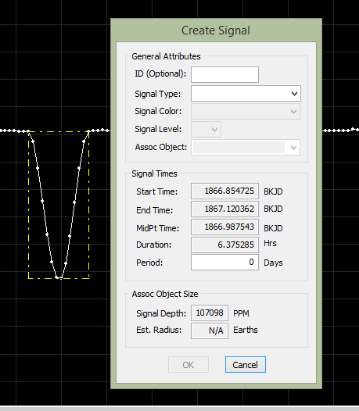
Planet Hunters forum Talk member Daryll LaCourse (Nighthawk_black) has converted all the Kepler Two Engineering Test Data and it is now available online for analysis at Planet Hunters.
Daryll LaCourse:
Daryll LaCourse:
" In early February an engineering test for two-wheel Kepler recorded 9 days of observations for ~2000 stars near Pisces. The original reduction pipeline is not suited to process this batch of data and will need to be overhauled (see this thread for the nitty gritty), but there is still some scientific value here and Martin Still has challenged the community to take a look. I think we should have a go at this! "
To that end I've extracted light curves from all of the available target pixel files using a brute force macro and piece of software available on the GO website called PyKE. The same 15x15 dimension pixel mask was applied on all targets; some have a secondary LC included that is slightly smaller. The complete output batch is 168mb worth of .FITS files and can be downloaded as a single .ZIP archive, or browsed individually.
.ZIP bundle Individual files
A grab bag of previously studied objects, including one confirmed planet hosting star called Wasp-28, were chosen for the target list and the catalog is broken up into the following sections:
EB
SC_target (short cadence)
Variable_Simbad
Multiple_Stars
Hot Stars
Cool Stars
Red Giants
GKM_dwarf
Eng_target
If you have recently joined the team or are a veteran but have previously only used the Classify and PH Talk interfaces, a 3rd party application will be required to look at these new stars. I would recommend downloading both of the following freeware utilities to experiment with:
TOPCAT by Mark Taylor: Stands for 'Tool for OPerations on Catalogues And Tables'. This program consists of a standalone Java file and for the purposes of these light curves it does not matter if you choose the Full or Lite version. Being that the former is only 26mb I would just grab that one. Should work on both Windows and Mac OSX.
LcTools by PlanetHunter Al Schmitt: This is a Windows based lightcurve viewer and signal processor developed for the Kepler project that Al has graciously updated for use with this data set. To install the software, please contact Al at aschmitt@comcast.net . You will notice that LcTools reduces FITs files to a smaller text format via 'LcGenerator'; I've already converted the bundle so it won't be necessary for everyone to do this. Once you have installed the product, just open this additional .ZIP file and follow the Readme.txt instructions.
A few things to consider when hunting around in these light curves:
If you want a particular star redone with a different mask size or a series of them, send me a PM and I will try to accommodate.
- Significant artifacts exist in ~25% or more of these LCs; in some cases the target was not in the center of the mask or more commonly artifacts have corrupted the observations. The former I can go back and fix manually with PyKE, but the latter will require a true dynamic pipeline to address properly. Also note that there are four negative outlier data points in my test files (BJD 1861.91, 1863.87, 1865.83 and 1867.79), so you will need to zoom in past those if using TOPCAT. If using LcTools for browsing, those outliers have been culled away and won't be an issue.
- The extraction masks are large compared to legacy data and applied in a generic fashion, as a result I expect a significant number of LCs have flux from neighboring sources that were blended in. The total degree to which this is going on is tough for me to judge at the moment; some of the point sources here are as dim as 18 while others are as bright as 9 !
- Most if not all of the interesting variables in the first four sections of the catalog are already noted in literature and such information can usually be found with an RA / Dec crosscheck on handy databases like the VSX website,.
- While these '"Two-wheel Concept Engineering Test" files do have EPIC numbers assigned, you will not find them on MAST in the new EPIC catalog area.
Have fun! "
You can visit this thread at Planet Hunters forum Talk and participate in the analysis here.
Wednesday, March 19, 2014
KIC 5871088 Possible Long Period Unlisted Saturn Size Planet

Planet Hunters forum Talk member Clue4fun4 flagged this transit drop in Kepler Quarter 16. It is a very long period planet that has shown up at the tail end of the Kepler data stream prior to the spacecraft going offline in 2013.
Comments by Kian Jek:
This is a very long duration transit that sneaked into the last days of Q16. Eyeballing it, the duration suggests a long period. The primary is a Type K subgiant.
Running a transit fit yields the following:
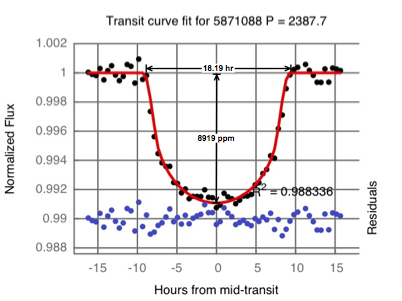
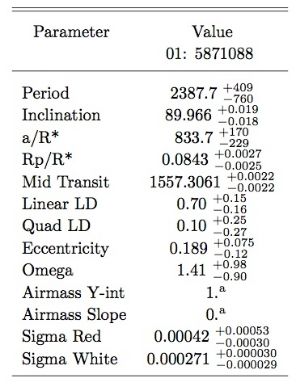
The period is very long, from 4.4 to 7.7 yr. The planet is approximately the size of Saturn, at 8.11x RE, based on a stellar radius of 0.882x Sol.
You can follow this planet at Planet Hunters forum Talk page here.
Thursday, March 6, 2014
Japanese Science Team Confirms Planet Hunters Background Dwarf Nova for KIC 11412044
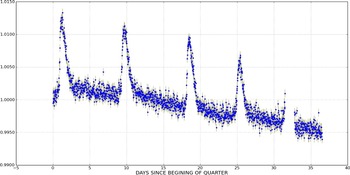
Planet Hunters Kepler Q5 light curve for KIC 11412044
Planet Hunters forum Talk member danasibogdan3 flagged this interesting light curve in Kepler Quarter Five that was later suspected by veteran members to be contaminated by a background dwarf nova . We posted an article on the possible dwarf nova at this site on July 24, 2012.
Japanese astronomers Taichi Kato and Yoji Osaki were alerted via our blog article:
"As mentioned in the acknowledgement of the paper, the paperThey recently wrote a science paper that was accepted by Publications of the Astronomical Society of Japan (PASJ) that you can view here.
is based on your discovery of a new dwarf nova in the Kepler
field of KIC 11412044, which we have come to know from your
web page:
http://keplerlightcurves.blogspot.jp/2012/07/dwarf-novae- candidates-at-planet.html "
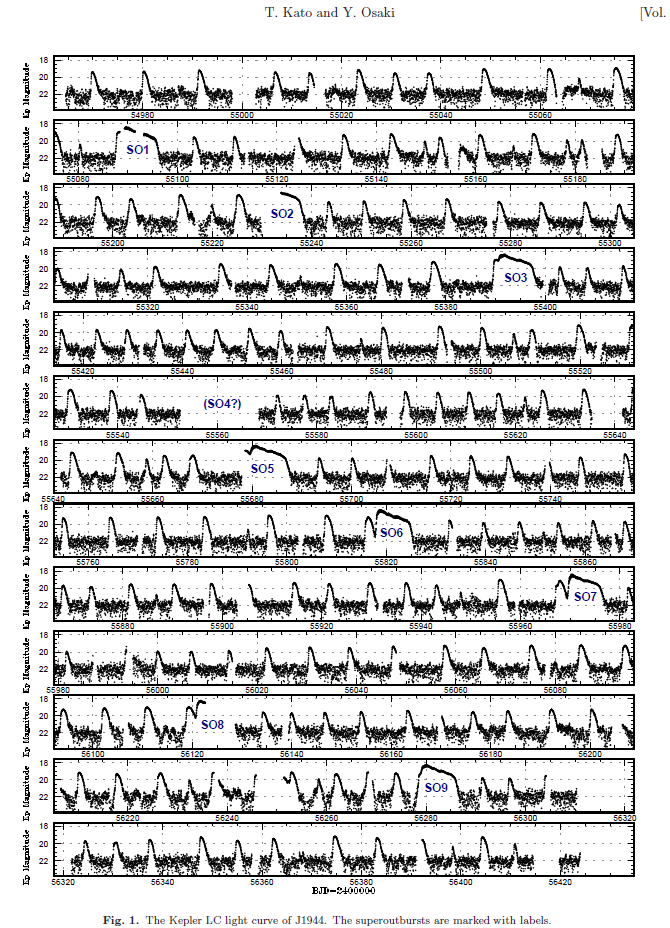
" The object is astrophysically very interesting as it has an extremely short orbital period and high outburst activity. "
"We studied one of these background dwarf novae, the one in the field of KIC 11412044 (hereafter J1944). This object was discovered by the Planet Hunters group as a
background SU UMa-type dwarf nova of KIC 11412044, in which superoutbursts and frequent normal outbursts were recognized. 2 Since it was bright enough and it was
frequently included in the aperture mask of KIC 11412044, the outburst behavior can be immediately recognized in Kepler SAP FLUX light curve of KIC 11412044."
"At this location, there is a GALEX (Martin et al. 2005) ultraviolet source GALEX J194419.33+491257.0 [NUV magnitude 21.3(3)] and we identified this source
as the UV counterpart of this dwarf nova (figure 3, Q16), confirming the suggestion in the Planet Hunters’ page. The superhump component and 0.0528 d component were
also confirmed at the location of this object (figure 3, Q14), and we consider that the 0.0528 d signal indeed comes from this dwarf nova."
Saturday, February 22, 2014
KIC 8016431 Possible Unlisted Planet Candidate

Planet Hunters forum Talk member Tesh90 flagged this possible unlisted planet candidate transit in the Kepler Q7 light curve. A second transit was identified near BJD 1420.2 along with transit analysis by Hans Martin (Zoo3hans).
Comments by Planet Hunters forum Talk member Kian Jek:
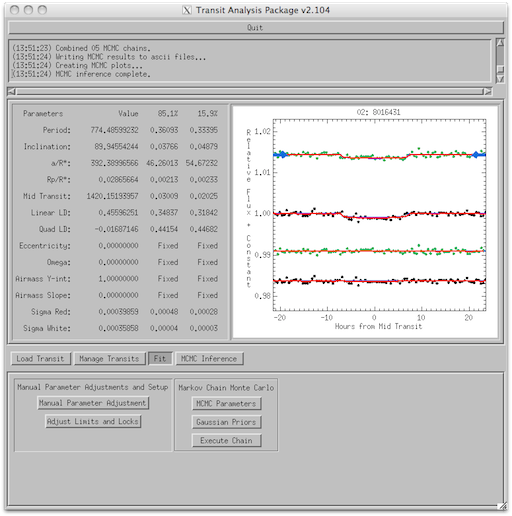
Here is the TAP run:
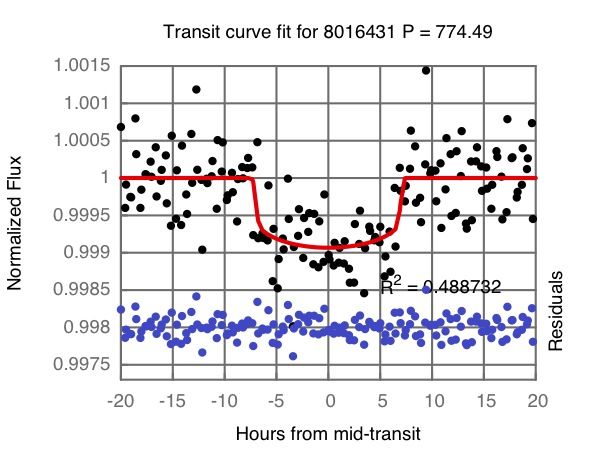
The transit curve fit:
The transit depth is 933 ppm with a duration of 15.07 hr. In order to make the orbital parameters consistent with the stellar data at MAST, I find that I get a better fit if the stellar radius is adjusted up to 0.89x Sol instead of 0.621, and the stellar mass set to 0.95x Sol. This is more reasonable for a 5671K Teff, and makes this closer to a Sol-like star.
If so, then we get a 2.79x (+/- 0.21) RE planet, orbiting at 1.624 (+/- 0.21) AU from the primary. The Teq is approx. 184K.
You can follow the thread on this planet at Planet Hunters forum Talk thread here.
Thursday, February 20, 2014
KIC 9396866 Possible Unlisted Planet Candidate in Habitable Zone

Planet Hunters forum Talk member Scienceweb flagged this possible unlisted planet candidate transit in the Kepler Q4 light curve. A second transit was identified near BJD 1342.5 along with transit analysis by Hans Martin (Zoo3hans).
Comments by Planet Hunters forum Talk member Kian Jek:
Here are the results of running a Mandel-Agol fit on the 2 transits.
From the fitted curve the depth is 290 ppm and duration is 25.2 hrs. The goodness of fit parameter, R2 is reasonable, at 0.59, and isn't too bad, given the circumstances. Since this is a Kp=12.59 star, the quality of the light curve could have been better, but even so, a 290 ppm transit does stand out quite clearly.
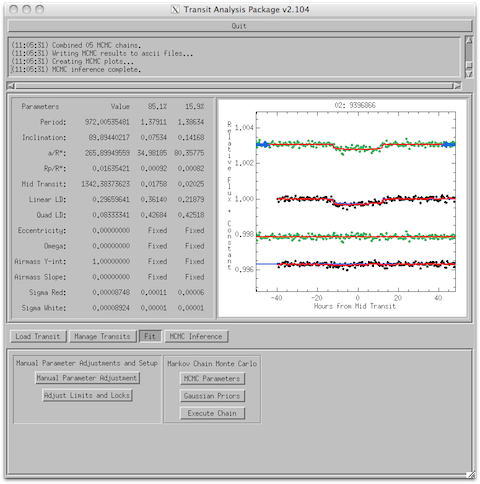
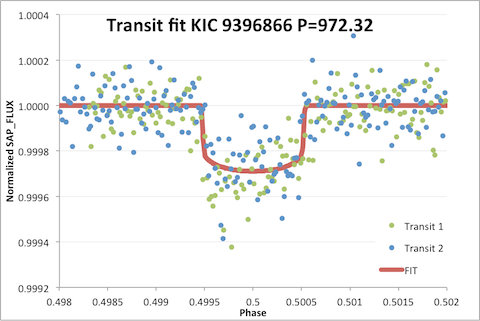
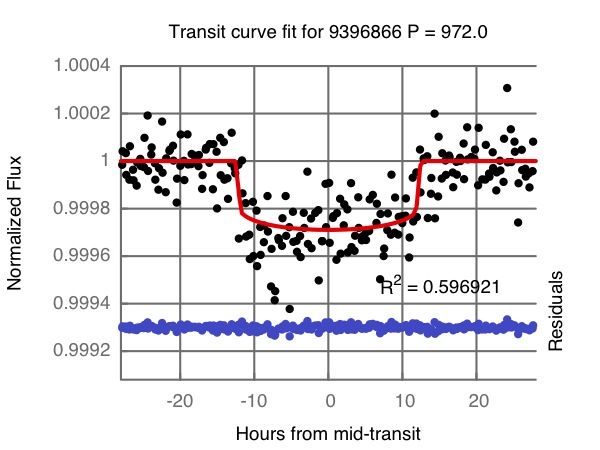
The problem is that MAST does not have stellar parameters for this star, but since we know the period, depth, duration and the Rp/R* and a/R* values derived from the transit fit we can make some guesses.The stellar primary is ~1.67x Sol and mass of ~1.23x Sol. The planetary radius is 2.98 (+/- 0.16) RE, orbiting at a distance of ~2 AU. The Teff of the star is not known, but an averaged guesstimate from the gr, J-K and G-K values gives something around 6000K. If so, then this is a possible HZ planet with a Teq of 236K. A little chilly, but this is actually warmer than Mars.You can read more about this transit at Planet Hunters forum Talk here.
Saturday, February 8, 2014
KIC 7105691 Unlisted Detached Eclipsing Binary with Highly Eccentric Orbit
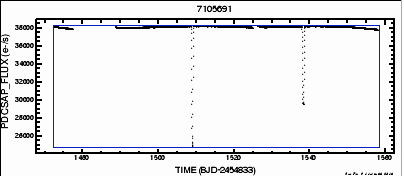
Planet Hunters Talk member Blammo flagged this star in Q16. It is part of an unlisted detached eclipsing binary star system that has now shown up for the first time in sixteen quarters of the Kepler light curves. The reason is that it has a highly eccentric orbit. Here is what PH forumTalk member Kian Jek has to say:
This is a very eccentric eclipsing binary for sure, but is it the real EB? An examination of the FITS file shows tiny APOs:
However, the vector plotted out shows the flux centroid shifting towards the tiny unmarked star at 1 o'clock. What I think is happening here is that during the dimming of the target, the presence of the companion in the halo pixel is shifting the centroid towards itself.
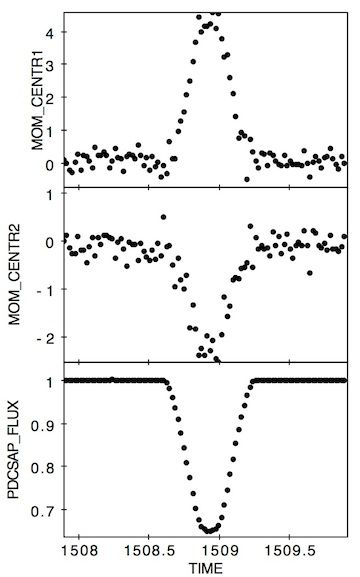
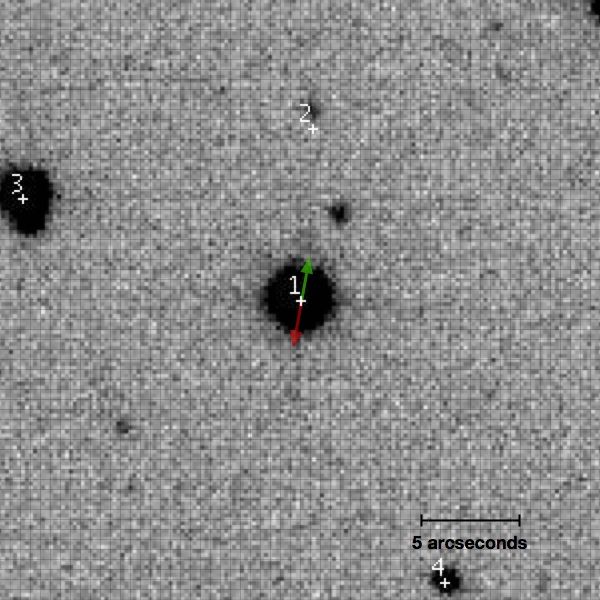
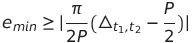
Let's try and calculate the eccentricity of this EB. I use the following relation, found in p. 86 of Kallrath and Milone (2009) to determine the minimum eccentricity of this EB:
where P is the period, t1, t2 are the epochs of the primary and secondary eclipses, in this case, for delta t1,t2, we have 29.8d as the separation between these 2 eclipses. P is not known, but we can assume that it is >1386d. Entering these values into the equation, we get a minimum eccentricity of 0.75.
This is quite an eccentric orbit, but it is not the most extreme eccentricity for an EB in the Kepler data set. That honor belongs to KIC 9214712, which has an e_min of 0.85 (see Dong et al)
You can read more about this star at the PH Talk thread here.
Saturday, January 25, 2014
KIC 8570781 Unlisted EB in Q16
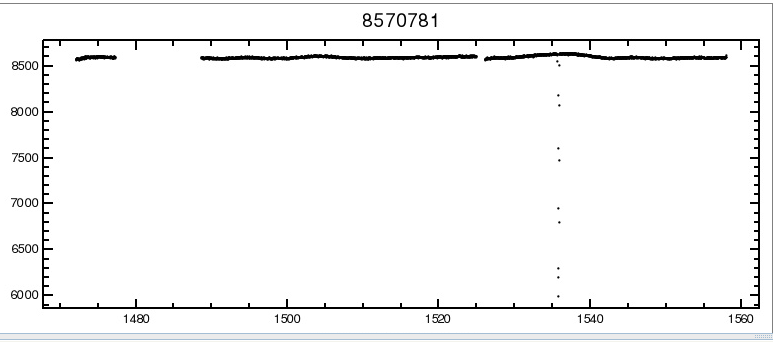
This Q16 light curve shows a long period detached eclipsing binary transit for KIC 8570781. Unfortunately, with the Kepler spacecraft no longer in operation, we will not be able to determine the EB's period.
You can view the thread at Planet Hunters forum Talk page here.
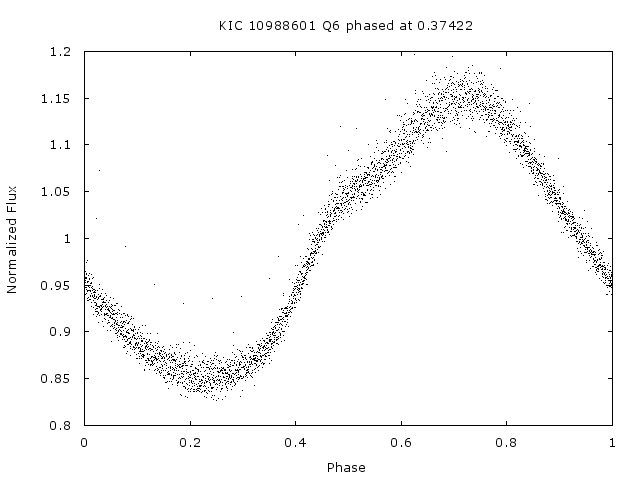
Unlisted RR Lyrae type C - KIC 10988601 contaminating KIC 10988583
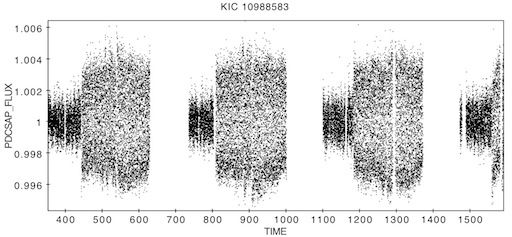
Planet Hunters forum Talk member Mike Barrett (mjtbarrett) posted an interesting LC for KIC 10988583 that has a phased curve indicative of a RRL type C. With forum Talk members assistance, the actual RRL type C was narrowed down in the Kepler field of view to star KIC 10988601.

Kian Jek's comments:
You can read more about this star on the Planet Hunters forum Talk thread here.
The phased curve certainly does have RRc characteristics but the amplitude is off. An inspection of the entire light curve tells us straight away that this is contaminated flux:
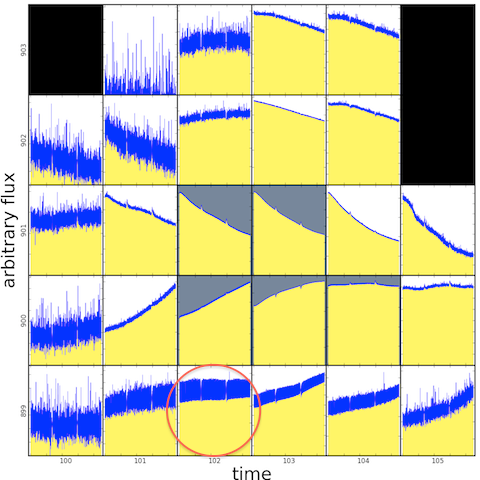
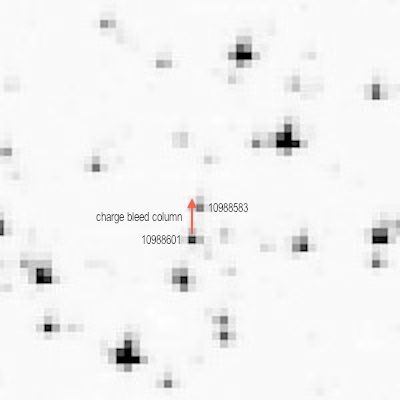
But where is it coming from? Looking at the Q6 TPF, it is clear that the contamination is in the halo pixels vertically below the target pixels.
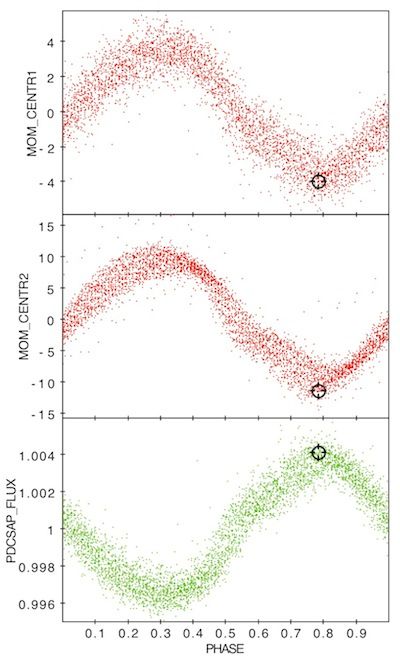
There are in-phase APOs as well:
To cut a long story short, here's the phased curve from that one halo pixel in Q6, col 102 row 899, normalized and it now does match the amplitude and period of a typical RRc variable:
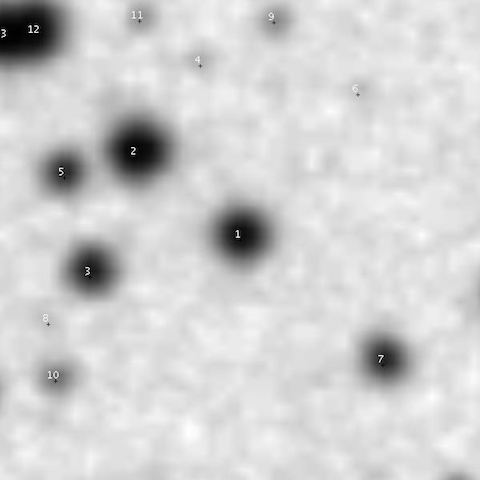
From the TPF, and the APO vector, it appears that the contaminating RRc is KIC 10988601, #2 in the Skyview image:
Even though 601 is more than 10 arcseconds away from the target, after re-orientation, it is directly below and one pixel to the left of the target. It is very likely there is a charge bleed along the column indicated since it is brighter than the target, causing it to contaminate that halo pixel. A quick check of the MAST parameters for KIC 10988601 tells us that it has a Teff of 7169K (F0/A9) and an estimated stellar radius of 2.287, almost exactly what we need for an RRc pulsator.
Saturday, June 22, 2013
GDOR-like Patterns and UKIRT Merged Stars

UKIRT image
At Planet Hunters we are good at detecting patterns in the Kepler light curves. So it is not unusual to see some speculation on our more interesting star patterns with visual anomalies. In this case we are posing some questions about Gamma Doradus-like (GDOR) stars with very close in neighbors showing up on UKIRT. Is there a link between possible contamination showing up in the field of view and the actual GDOR-like pattern in the light curve? Are we seeing the effect of a background GDOR as contamination? Or is this simply a random event, coincidence with no relationship? Taking this speculation one step further, can there be, in some instances, a gravitational link between very close in neighbors showing up in the field of view of those stars that appear to be merging? Can some of the light curve patterns be indicating a binary star system relationship?
Tom128
Here are some examples taken from our PH GDOR list:
KIC 10681464 Listed on VSX as a SPB - http://talk.planethunters.org/objects/APH43125465
UKIRT
KIC 10199218 http://talk.planethunters.org/objects/APH73018369

UKIRT
KIC 5301537 http://talk.planethunters.org/objects/APH72114406

UKIRT
KIC 10728428 http://talk.planethunters.org/objects/APH53074550

UKIRT
KIC 12218729 http://talk.planethunters.org/objects/APH72010654

UKIRT
KIC 2695344 http://talk.planethunters.org/objects/APH73093495

4 months ago
Tom128
Yes, it seems instead of false positive transit drops we see these light curve patterns. I did not do any contamination analysis on any of these light curves, but they seem to have the same visual merged or close in neighbor. Here are a some more examples:
KIC 3441414 http://talk.planethunters.org/objects/APH22140442

UKIRT
KIC 4076350 http://talk.planethunters.org/objects/APH52022370

UKIRT
KIC 1295531 http://talk.planethunters.org/objects/APH71094127

UKIRT
4 months ago
arvintan
here's a couple more from my collection:

KID 6782360: http://talk.planethunters.org/objects/APH52098313

KID 5689219: http://talk.planethunters.org/objects/APH10038724
4 months ago
Tom128
Here is another example of a GDOR-like LC with a close neighbor on UKIRT:
KIC 5650341

http://talk.planethunters.org/objects/APHE2000oht
UKIRT
You can follow this thread on the Planet Hunters Talk Science board here.
Subscribe to:
Posts (Atom)
An Automated Search for Transiting Exocomets- HD 182952 (KIC 8027456)
A team of astronomers led by Grant M. Kennedy , discovered a potential third comet system in the Kepler prime field data of HD 182952 (KIC...

-
Earth size Exomoon orbiting a Saturn- like planet - Wikipedia If an exomoon is going to be observed in the Kepler light curves it will h...
-
Comment by Kian Jek: "So far, Planet Hunters have found three background dwarf novae (DN) candidates in the Kepler public data, and ...
-
 There has been lots of exciting news about alien worlds recently with the announcement of confirmation studies for over 41 Kepler exo...


KID 5728217 http://talk.planethunters.org/objects/APH10027511
UKIRT.