Showing posts with label Light Curves. Show all posts

Monday, September 3, 2012

Three Giant Heartbeats


Highly eccentric but non-eclipsing binary systems have been observed by the Kepler mission, so far dubbed as 'Heartbeat Stars' due to the odd resemblance of their light curves to a classic medical EKG monitor. In these cases the periodic brightening or dimming variability is caused not by massive stellar internal organs but instead from tidally induced distortions caused by the companion star as it makes its close pericenter passage; these 'eccentricity pulses' have been observed to cause a wide range of effects on the light curve. In cases of dimming these distortions are often not in the same magnitude league as a true eclipse or transit, allowing them to be missed by initial pipeline transit searches. They can sometimes resemble types of stellar variation or pulsation, but their periodic nature sets them apart.

Literature from Dong, et al and Welsh, et al explored an initial set of benchmark systems (including the amazing target KOI-54); more were identified in the paper 'A Class of Eccentric Binaries with Dynamic Tidal Distortions Discovered with Kepler' by Thompson, et al. Hot stars in the A and F class ranges seem to lend themselves to betraying these signals and make up a majority of the identified group. A crowd sourced effort at PlanetHunters, where manual search methods were already under way for exoplanets lost in the noise, quickly began to identify additional eccentric binary candidates.

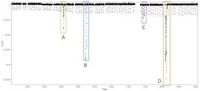
Not all Heartbeat stars encountered so far fit the A to F class model however, with a small subset of new candidates being found in the G and K type range. Three such departures of interest I've highlighted below are found associated with candidate targets KIC 8210370, 8095275 and 7431665; all listed as Type K Giants with radius far exceeding that of Sol and effective temperatures below many of their previous Kepler listed HB counterparts.

KIC 8210370

A Type K with radius 10.7x Sol and a period of ~154 days:


"Cannot see any secondaries but find it unlikely given the stellar parameters that these are going to be similar sized objects. It may well be an EB, but I think it could instead be a Heartbeat Binary.

We've seen a few now. The properties of Giant stars make them very suitable for observable heartbeat effects, which probably explains why we have a not-insignificant number given how Giants are a relatively small subset of Kepler targets."  -PlanetSam
Source


KIC 8095275

A Type K Giant with radius 6.8x Sol and a period of ~45 days:

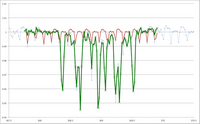
"The spike after the eclipse is now very apparent. There doesn't seem to be a corresponding one before the minima. The waveform looks very much like a heartbeat binary - tidally excited pulsations caused by a slightly eccentrically orbiting body. But the orbit doesn't look eccentric, otherwise the minimas would show the phase difference, and the primary is a Type K giant instead of a Type A.

One possibility is that the period is actually ~23d and there is only one eclipse, the other being out of line-of-sight, and the orbiting object indeed causes some pulsation that results in the shoulder at the egress of the eclipse."  -Kianjin
Source

KIC 7431665
 A Type K Giant with radius 9.0x Sol and a period of ~281 days


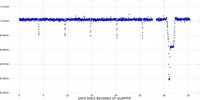
"...there are asymmetrical bulges on either limb, very reminiscent of SPH10004034 or KID 10614012. It is possible that this is actually due to a heartbeat-like tidal interaction that deforms the giant star, i.e. the secondary (which is a small red dwarf perhaps) is in an extremely eccentric orbit that causes this when it is close to periastron."  -Kianjin
Source

Further Info:
Heartbeat Stars Presentation by Susan Thompson


Saturday, September 1, 2012

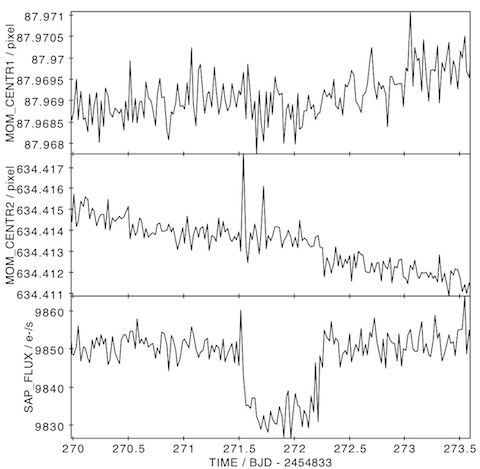
Unlisted Planet Candidate KIC 8636333

This is the first transit in quarter three of the Kepler data in 2011. Here is forum Talk member zoo3hans' comment:
This could be a 3.9 R_Earth planet @ 2.4 AU from its star with an estimated period of 1435 days and T = 152 K.

Kian Jek's comment:
 Looks clean to me, no APOs detected in the FITS file.


You can follow this planet candidate here.

Sunday, August 19, 2012

Kepler Unlisted Gamma Doradus Star Collection


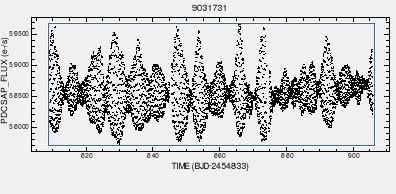
Planet Hunters forum Talk members have assembled an evolving Kepler "Data Mining" list of unlisted and known Gamma Doradus (GDOR) variable stars like KIC 8364249 above. You can check out the 26 page and counting, collection here.

KIC 9031731 at quarter 9.


This is a pattern recognition list and many of the entries may fail as GDOR stars after further analysis. The list may also provide some exotic stars not currently classified. Consider this thread to be a working list of eligible stars that visually look like GDORs. Members, with the expertise, can later pull interesting stars from the list for further investigation.

From our good friend wikipedia: "Gamma Doradus variables are stars which display variations in luminosity due to non-radial pulsations of their surface. The stars are typically young, early spectral F or A type main sequence stars, and typical brightness fluctuations are 0.1 magnitudes with periods on the order of one day. This is a relatively new class of variable stars, having been first characterized in the second half of the 1990s, and details on the underlying physical cause of the variations remains under investigation. The prototype is Gamma Doradus."

Saturday, August 4, 2012

KIC 10074700 Unlisted Eclipsing Binary with One Year Period

KIC 10074700 is an unlisted detached eclipsing binary star system identified by Planet Hunters forum Talk members with a one year period.

Sunday, July 29, 2012

Hauling In The Nets On Kepler Q7 - Q9


It's been an exciting weekend for the amateur volunteers in the Planethunters community! With the release to the public realm of Kepler data for Quarters Seven through Nine, we've finally been able to re-characterize and re-examine a myriad of targets placed on watch lists at various points since the projects inception, looking for new and additional transits and eclipses.

No matter how many light curves we sift through in Classify or on the PH Talk forum it never gets old-- there is always something challenging to figure out waiting around the corner, and the past several days have been no exception to that rule. In addition to a host of new exoplanetary and binary star system candidates--some of which I'll highlight here--we've run into fresh new mysteries that will no doubt help keep everyone quite busy while we wait for the next public data release, and eventually the end of the proprietary period altogether as the extended mission proceeds.

Even with Kepler's exquisite light curve data quality, there are many considerations that could subsequently invalidate any of these suspected new objects, from blended background sources and astrophysical artifacts to software or hardware introduced issues. But we're confident many of them will hold up to future follow up performed by the scientific community in the months and years to come. 

It's also quite possible that with the the imminent release of a new Kepler Object of Interest catalog, some will immediately turn out to be co-discoveries made alongside our friends around the world with the big scopes; nonetheless it's a powerful testament to the skill of the human eye, and to good old fashioned teamwork!

Potential Exoplanet Candidates

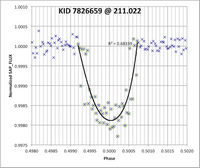
KID 7826659
Possible 6.7xRe Habitable Zone Candidate with Period of ~211 days

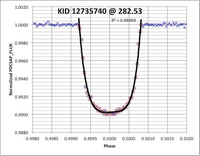
KID 12735740
Possible 1.1xRj Habitable Zone Candidate with Period of ~282 days

KID 11253827
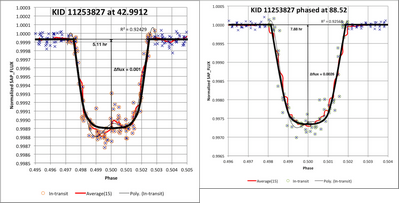
Possible Multplanetary System w/ a 4.0xRe at Period of ~42 days and a 6.49xRe at Period of ~88 days

KID 8827930
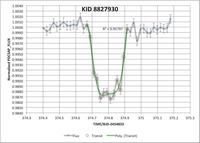
Possible 0.78xRj Candidate with a tentative Period of ~288 days

KID 5649325
Possible 0.96xRj Candidate with a Period of ~195 days

KID 11716643
Possible 3.8xRe Candidate with a tentative Period of ~466 days


Potential Stellar Companion Objects / Trinary Systems

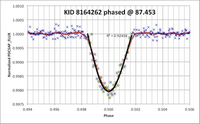
KID 8164262

KID 6964043


KID 2856960


Probable Detached Eclipsing Binaries

KIDs
6756202,   P= ~292
7674050,   P= ~472
4586468,   P= ~506
7117003,   P= ~429
10074700, P= ~365
4663623,   P= ~359
7431665,   P= ~280

A big Thanks to everyone who took time out of their day (or night, as the case may be) to do some cross-checking and vetting with us this weekend!


An Automated Search for Transiting Exocomets- HD 182952 (KIC 8027456)

A team of astronomers led by Grant M. Kennedy , discovered a potential third comet system in the Kepler prime field data of HD 182952 (KIC...