Showing posts with label exoplanets. Show all posts

Sunday, October 28, 2012

A Potential Super-Earth Orbiting KIC 3732035?


There have been many exciting developments in the study of alien worlds this month, not the least of which being discovery announcements for a new world next door in the triple star system Alpha Centuari and another, much further away within a hierarchical quadruple star system that has been re-christened 'PH1'. This latter case is the first confirmed exoplanet from PlanetHunters and was first  noted by veteran project members Kian Jek and Robert Gagliano! For more on its discovery and characterization check out the official PlanetHunters Blog.

These events have driven a flood of activity on PH Talk. Many are new users assessing light curves for the first time, but some are individuals dropping by to check up on past favorites. Such was the case with 'Trenton1979' and his bump given to the thread for Kepler target KIC 3732035.


 A possible exoplanet candidate was noted here over a year ago in the entry for Quarter 1. An updated check reveals that at least five plausible transits exist in the public data set that can be culled from the noise, occurring at an interval of ~139 days.


The host star is a Type G of estimated 5786(K) and 0.9 radius compared to our sun, found at a magnitude of 14.2 in the Kepler FOV.

Kian Jek's observations:

"The light curve was detrended, preserving the transits and folded. During this process, it was discovered that the 2nd transit at 292 was problematic, as it was ill-defined, too shallow and short in duration, so it was removed. With the remaining 5 transits, I was able to get a reasonably good transit curve fit above (original polyfit in green)."
"The transit duration still comes out a little on the long side, at 10.83 hr, given that a central transit of a 0.864x Rsol star is 8.33 hr, so it's possible the stellar radius is wrong, or we are looking at an eccentric orbit. The radius of the planet, assuming a 0.864x Rsol star, is around super-Earth size, at 2.11x RE, and an orbit of 0.51AU. Mass of the planet estimated (very roughly) to be 9.6x ME. The Teq is approximately 328 to 335K, which is very hot, but water is still liquid, so technically this planet is in the HZ, although its orbit lies between Mercury and Venus, and if it has an atmosphere, could turn out to be much hotter than this."

Although no clear centroid shifts appear to accompany these transits, they are shallow and thus proper follow up by observatories would be required to completely rule out the possibility that this is a false positive caused by a faint background binary.

More transits seem to be present in the Q10-Q13 data; if accurate on the radius this target is amongst the smallest potential exoplanet candidates characterized at PH Talk so far!


Saturday, October 13, 2012

Unlisted Planet Candidate KID 2581554


Planet Hunters forum Talk members have identified KID 2581554 as a planet candidate with a very short period.

Kian Jek:
The host is a heavily spotted Type K subgiant with a rapid rotation of ~8 days resulting in a lot of variation which made the 17 transits hard to isolate. There appear to be no correlated APOs. Transits were masked out by hand and the curve detrended:

The light curve is then folded by hand again to obtain a period of 47.148 and a rather good-looking transit curve:


The transit duration is very short because of the high impact parameter of 0.93. The transit depth corresponds to a 7.47x RE planet at a distance of 0.28AU and a Teq of 577K.
 UPDATE: Phased APO plot for Q5 and Q9:


You can follow the discussion for this planet at Planet Hunters here.


Monday, August 20, 2012

KIC 2581316 - Unlisted Planet Candidate or Eclipsing Binary?


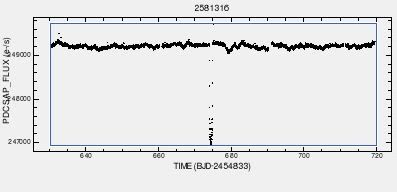
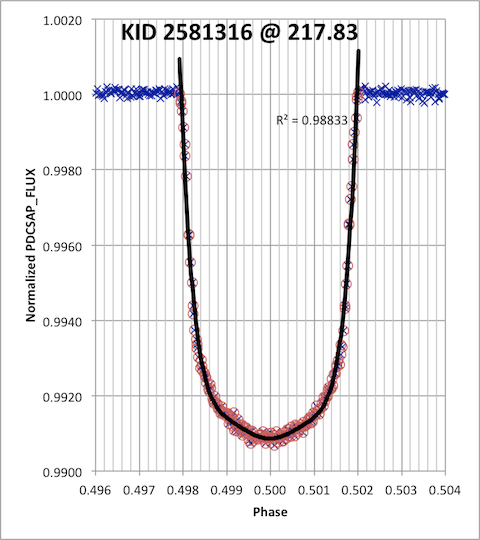
Planet Hunters forum Talk members flagged this transit for KIC 2581316 around May of 2011. There are now four observed transits through quarter 9 in the released Kepler data set. It appears that this transit was originally flagged as a false positive, but no longer appears on that list. The star has a magnitude of 11.69.

Q9 time plot


Here is Kian Jek's comment:
"From the profile it looks like a classic planetary transit, and may not be an EB after all - rapid drop offs, with a clustering of data points at a U-shaped bottom. Unfortunately we don't know the radius of the star."

Here is Daryll Lacourse's comment on Keppixseries below:
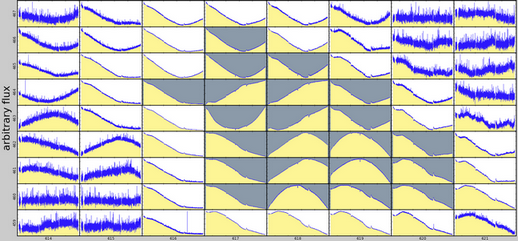
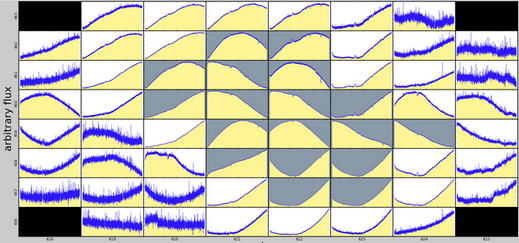
"July released target pixel files for KIC 2581316; the transits/eclipses seem visible and included within the large optimal aperture masks in each case. Contamination does not seem to be involved."


Full view


 Full view

Visit the Planet Hunters forum Talk page for more information on this transit here.


Tuesday, August 7, 2012

Timing Is Everything


I have a quickly growing appreciation for the importance of TTV (transit timing variations) with respect to the study of extra solar planets and Kepler data in general. TTV studies have been at the forefront of Kepler research for well over a year now, revealing the presence of additional non transiting partners to confirmed exoplanets and offering us powerful new insights into the formation history and dynamical interactions within these star systems. Particularly important benchmark systems can be found detailed in the great seven part series "Transit Timing Observations From Kepler"  (available on ArXiv.org), in the recent submitted paper "Kepler 36: A Pair Of Planets With Neighboring Orbits And Dissimilar Densities", (displayed in header image) and a host of other multi-candidate system studies available in the current literature.

Planetary bodies are not the only objects subject to the tug of a neighbor. We know that the same laws of physics apply everywhere (at least at this point in the history of the Universe!) and we also know that many systems are in fact double star or binary configurations, something that perhaps makes our own home neighborhood a little more noteworthy being it lacks a such a stellar companion. While less common than binaries, triple (trinary) or greater arrangements are very possible and well known in the current literature; as many as 20% of binaries may host a third companion object. Where our viewing angle allows for eclipses, we have means to measure eclipse timing variations in similar manner to TTV's. One well known example in the current Kepler catalog takes the form of KOI-126, an eclipsing pair of M-dwarfs in orbit around an F class star.

Since the Q7-Q9 Kepler data release, additional targets of interest displaying tertiary eclipses and timing variations have been noted by PH users. The first is found at (KIC 5255552): a ~15 K-magnitude target with new anomalous eclipses visible in Quarter 7, suggesting a companion object to a detached binary pair which is itself in a ~34 day period. This companion appears to be known to the Kepler Science team already, although it has yet to be fully modeled and characterized with the available dataset.

O-C diagram for 5255552:


The second case was first noted earlier this year on PH Talk and appears to be a new trinary candidate; it exhibits obvious tertiary eclipses at target KIC 6964043 and preliminary O-C diagrams and plots show some amazing variations that can be measured not on the order of seconds or minutes--but hours!


Jeff L. Coughlin of New Mexico State University stopped by PH Talk and offered his suspicions that this system may best be explained as: "...a G5V star in a 238 day eccentric orbit around a pair of 10.7 day eclipsing M3V+M4V stars, all eclipsing each other."

Some further discussion can be found here.

Plots courtesy of Kian Jek and Jeff Coughlin. 
Banner image credit:  NASA; Frank Melchior, frankacaba.com; Eric Agol

An Automated Search for Transiting Exocomets- HD 182952 (KIC 8027456)

A team of astronomers led by Grant M. Kennedy , discovered a potential third comet system in the Kepler prime field data of HD 182952 (KIC...