Saturday, September 22, 2012

KIC 5640750 - Long Period Giant Eclipsing Binary


Kian Jek:

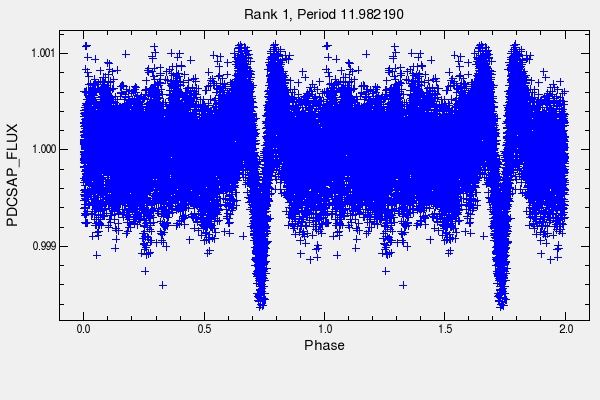
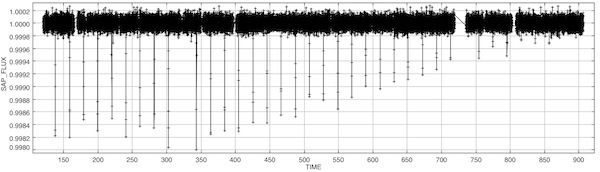
The eclipse seen is truly humongous - we are looking at a 6.7 day eclipse (or approx. 160 hours) with a depth of 6.6%! There appears to be another eclipse right at the end of Q11, with a depth of about 1.8%. Just catching a glimpse of this other eclipse is fortuitous because it allows us to get an estimate of the stellar parameters of this EB.


For a giant EB with a total or annular eclipse, the flat-bottomed eclipse is generally the secondary eclipse, where the secondary is occulted by the giant primary. Since it is deeper than the primary eclipse (the one at the end of the data), we can surmise that the secondary must be brighter than the primary. We don't know what the period is, but it must be >1098 days. A reasonable estimate would be approx. 1300 days or longer, and if the primary is 10.365x Sol, then the secondary could be a 1.45x Rsol, Type F star with a Teff of 6300, with an orbit whose semi-major axis is ~ 3 to 3.5 AU. A binary with this configuration will give the observed depths of 6.67% and 1.8% for the secondary and primary eclipses.
You can track the progress of this eclipsing binary star system here.

Monday, September 17, 2012

The Twelfth PlanetHunters Habitable Zone Candidate


Sharp eyed volunteers at PlanetHunters have identified another set of transits that seem to reveal another exoplanet candidate in the habitable zone of its host star.

One of the transits visible in Quarter 6 PDC_SAP flux

The target is KIC 4947556; a magnitude 13.2 star interpreted in the catalog as a Type K dwarf of 4907(K) and a stellar radius of 0.9 compared to Sol. The public light curve exhibits significant variations throughout the time series, resulting in a group of transits that are not immediately obvious to the eye despite their ~141 day period.

Example of PDC_SAP time series for Quarters 4 and 5
The surrounding field of view is relatively clear and strong offsets are not present in the data correlating to the transit events, however there is a possible secondary source in the form of a very slight 'bulge' that will need to be evaluated for interference along with the usual checks for confusion with a faint eclipsing binary in the background.

Surrounding field sources
Preliminary fitting and characterization work done by PH Talk users Zoo3hans and Kianjin indicate this candidate may exist in the form of a 3.68xRe 'Warm Neptunian' orbiting at 0.52AU with an equilibrium temperature of 278 to 283K. 

                                          PH Talk  Discussion

This candidate follows close on the heels of the potential HZ exoplanets found earlier this month at KIC 9886255 and KIC 4820550.


Further recent Exoplanet reading:

New Mission Manager Update

Do two of the top 6 'Potential Habitable Planets' @ Gliese 581 actually exist?


Extremities of the Exoplanet Density Distribution  

PlanetHunters Blog @ Zooniverse: Sounding Good


The Nine PlanetHunters Habitable Zone Candidates


Sunday, September 16, 2012

The Eleventh PlanetHunters Habitable Zone Candidate


Manual reviews of the light curve for Kepler target star KIC 9886255 have revealed the presence of some intriguing transits on a ~106 day period, visible in the public data for Quarters 3 through 9.

A transit in corrected flux for Quarter 3
The Kepler Input Catalog calls out 9886255 as a Type K star of 15.8 apparent visual magnitude, 5137(K) and an assumed radius of  0.6 compared to Sol.

A potential follow up issue exists with this target due to another source close in the field, identified as KIC 9886258 and seen with tag '#2" in the Skyview image below:


Currently this neighboring source is not a monitored target and no light curve exists on record for it. Preliminary investigation suggests no active pixel offset is occurring that might indicate the noted transits actually belong to this star as opposed to 9886255, however the close proximity and risk of blended flux is a cause of concern c/t analysis of this candidate.

If we take the data at face value, the depth and duration suggest a potential habitable zone exoplanet, albeit one that may be in a slightly eccentric orbit around its host star.

"Here's close-up of the transit, and although the flux values are spread quite widely and individual transits show a lot of variation, the averaged plot with a polynomial fit shows a U-shape and flat-bottom . The measured depth is 2500ppm with a duration of 7.37hr. This is at odds with a computed central transit of 5.6hr. If this is planetary this could be explained by an eccentric orbit. Using the stellar parameters provided in MAST, I estimate a 3.26x RE planet, at 0.4 AU and a Teq of 274K, putting this in the HZ." -Kianjin

Like most of the other habitable zone candidates we've seen at Planethunters, this exoplanet would weigh in far heavier than Earth; if the calculated radius is accurate it belongs to the Neptune or sub-Neptune domain as opposed to a Super-Earth, and likely has a thick, high pressure atmosphere. Additional Kepler data is going public soon so it will be interesting to see if any longer period transits show up for this system that may have been lost previously in time series data breaks and gaps.

Latest numbers have the official Kepler count at 2405 exoplanet candidates awaiting follow up and amongst confirmed systems 127 of the 834 known!

Saturday, September 15, 2012

KIC 4949187 - Possible Heartbeat Binary Star System


Planet Hunters forum Talk member planetsam identified this light curve for KIC  4949187 as a possible unlisted heartbeat binary star system, a class of tidally excited eccentric binaries. This new class of stars was first discussed at the Kepler Science Conference in  December of 2011. View Susan Thompson's Kepler video presentation here.

Kian Jek provided the phased curve below:


You can follow the discussion at Planet Hunters Talk forum here

KIC 11869052 - Disappearing Eclipsing Binary


Kian Jek posted this detrended, combined light curve for KIC 11869052 above showing that the eclipsing binary star system has an evolving orbit with its transit drops diminishing over time. No secondary transits are visible which may indicated that they have already disappeared. This is a published eclipsing binary.


Kian Jek:

Here's the OC-plot. The TTVs aren't that marked, about 20 minutes at maximum and they tend to vary a bit, but the curve fits look good. Probably a long period tertiary in there somewhere. The eclipses are very shallow, this EB probably has been eclipsing for quite some time, and I guess we're very lucky to catch this just as it disappears (just what are the odds of this happening?)

Planet Hunters forum Talk member troyw spotted the evolving orbit using the Amateur Kepler Observatory program (AKO). Notice how the horizontal signal indicating a transit is fading out from left to right.

This system has a fading set of primary transits with a slight wobble (TTVs) in the transit line. No secondary transits (that I could see).
p = 20.5469d
 You can follow this eclipsing star system on the Planet Hunters Talk thread here.

Wednesday, September 5, 2012

The Tenth PlanetHunters Habitable Zone Candidate


Another potential exoplanet orbiting in the habitable zone of its host star has been identified during a review of Quarter 5 light curves on PlanetHunters, this time around a G type star. The Kepler Input Catalog lists a radius of .8x Sol and a Teff of 5586(K) for this 13.9 Kmag target, designated as 4820550. The uncorrected light curve exhibits a fair degree of variability but so far in the public data set a total of four transits are found in Quarters 3, 5, 7 and 9 respectively. The period of these events is 202 days.


Some preliminary investigation indicates no obvious offsets, and KIC 4820550 does not appear to be included in the current Kepler Object of Interest catalog, nor does it appear in the official False Positive list.

The light curve before and after detrending to remove the stellar variability and trending:


To confirm this exoplanet candidate an important host of confirmation checks would need to be performed, including advanced screening for close background / foreground binaries and spectroscopic follow-up of the host star, but initial characterization is encouraging and shows this target may indeed reside inside the habitable zone where liquid water states could exist. The potential radius would rank this exoplanet slightly above that of the Neptune, placing it well outside the Super-Earth regime. Atmospheric colors and distribution in the header graphic were chosen arbitrarily; it's interesting to speculate if this body originally formed further out as an Ice Giant similar to the pair in our own solar system, and has since migrated inwards to its current position.


"Based on the plot, I have a transit depth of 2500ppm and duration of 4.56 hr. This works out to a planet with radius 4.4x RE and a somewhat high impact parameter of 0.86. It orbits the primary at a distance of 0.62 to 0.65AU and has a Teq of 273 to 280K, putting it in the HZ!"  -Kianjin
Source

This candidate increases the PH list of potential habitable zone targets to total of ten!

Monday, September 3, 2012

Three Giant Heartbeats


Highly eccentric but non-eclipsing binary systems have been observed by the Kepler mission, so far dubbed as 'Heartbeat Stars' due to the odd resemblance of their light curves to a classic medical EKG monitor. In these cases the periodic brightening or dimming variability is caused not by massive stellar internal organs but instead from tidally induced distortions caused by the companion star as it makes its close pericenter passage; these 'eccentricity pulses' have been observed to cause a wide range of effects on the light curve. In cases of dimming these distortions are often not in the same magnitude league as a true eclipse or transit, allowing them to be missed by initial pipeline transit searches. They can sometimes resemble types of stellar variation or pulsation, but their periodic nature sets them apart.

Literature from Dong, et al and Welsh, et al explored an initial set of benchmark systems (including the amazing target KOI-54); more were identified in the paper 'A Class of Eccentric Binaries with Dynamic Tidal Distortions Discovered with Kepler' by Thompson, et al. Hot stars in the A and F class ranges seem to lend themselves to betraying these signals and make up a majority of the identified group. A crowd sourced effort at PlanetHunters, where manual search methods were already under way for exoplanets lost in the noise, quickly began to identify additional eccentric binary candidates.

Not all Heartbeat stars encountered so far fit the A to F class model however, with a small subset of new candidates being found in the G and K type range. Three such departures of interest I've highlighted below are found associated with candidate targets KIC 8210370, 8095275 and 7431665; all listed as Type K Giants with radius far exceeding that of Sol and effective temperatures below many of their previous Kepler listed HB counterparts.

KIC 8210370

A Type K with radius 10.7x Sol and a period of ~154 days:


"Cannot see any secondaries but find it unlikely given the stellar parameters that these are going to be similar sized objects. It may well be an EB, but I think it could instead be a Heartbeat Binary.

We've seen a few now. The properties of Giant stars make them very suitable for observable heartbeat effects, which probably explains why we have a not-insignificant number given how Giants are a relatively small subset of Kepler targets."  -PlanetSam
Source


KIC 8095275

A Type K Giant with radius 6.8x Sol and a period of ~45 days:

"The spike after the eclipse is now very apparent. There doesn't seem to be a corresponding one before the minima. The waveform looks very much like a heartbeat binary - tidally excited pulsations caused by a slightly eccentrically orbiting body. But the orbit doesn't look eccentric, otherwise the minimas would show the phase difference, and the primary is a Type K giant instead of a Type A.

One possibility is that the period is actually ~23d and there is only one eclipse, the other being out of line-of-sight, and the orbiting object indeed causes some pulsation that results in the shoulder at the egress of the eclipse."  -Kianjin
Source

KIC 7431665
 A Type K Giant with radius 9.0x Sol and a period of ~281 days


"...there are asymmetrical bulges on either limb, very reminiscent of SPH10004034 or KID 10614012. It is possible that this is actually due to a heartbeat-like tidal interaction that deforms the giant star, i.e. the secondary (which is a small red dwarf perhaps) is in an extremely eccentric orbit that causes this when it is close to periastron."  -Kianjin
Source

Further Info:
Heartbeat Stars Presentation by Susan Thompson


An Automated Search for Transiting Exocomets- HD 182952 (KIC 8027456)

A team of astronomers led by Grant M. Kennedy , discovered a potential third comet system in the Kepler prime field data of HD 182952 (KIC...