Tuesday, November 20, 2012

Unlisted Planet with 14 -17 year period transiting KIC 10842718

Kepler Q2 light curve at NEA

Only one transit in Q2, but we may have to wait a while for the next couple of transits to confirm that a  8.64x RE planet is transiting  KIC 10842718. The estimated period is 14-17 years!

Kian Jek:


The period given by the model is between 5135 to 6275d (14 to 17 years!) for a 8.64x RE planet.

You can follow this planet candidate on the forum Talk thread here. 

Monday, November 12, 2012

Unlisted RR Lyrae type ab - KIC 1570352

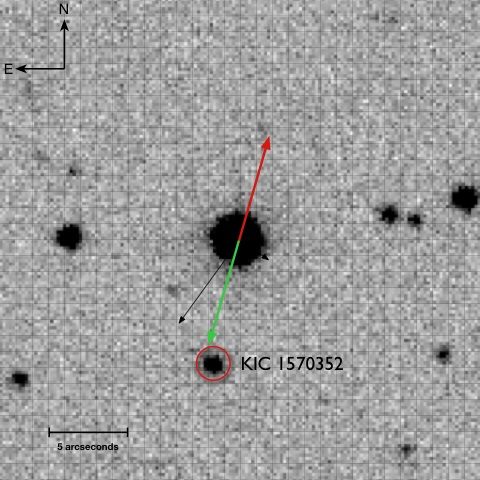
UKIRT image showing direction (green) of RR Lyrae from target star by Kian Jek

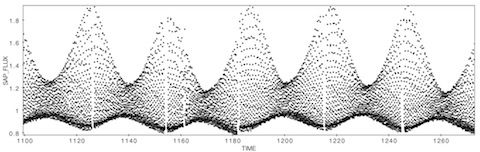
Planet Hunters forum Talk members Dolorous EDD and Zoo3hans flagged a background RR Lyrae type ab star that was contaminating the the Kepler light curve for star KIC 1570349 below:


zoo3hans:
The LC shows massive variation through the different quarters, so I assume it's contamination. It could be a background RR_Lyrae type star.

lc

Kian Jek:
 
kianjin
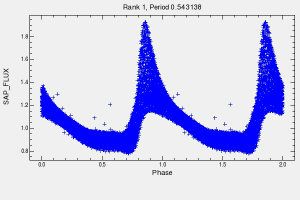
Yes indeed Hans, it's very likely contamination from a BG RRLab. Here's the phased curve which matches the profile of an RRLab in period but the amplitude is too low - it should be at least 80% or more at the peak:


APOs show the flux centroid shifting during the variation.


These can be traced to the nearby star KIC 1570352, a magnitude 18.4 star. There isn't much in the way of stellar characteristics known, but the g-r value of 0.175 suggests a Type AF star, with a Teff around 7000K, which makes it just right for an RRLab.


 Chris Lintott:
zookeeper (moderator)
 
I've been in touch with Robert Szabo, our resident guru for such things, and he confirms this is a new discovery of a RRLyr of type ab - fabulous stuff and congratulations to all involved.

You can follow the discussion on this star at Planet Hunters forum Talk here.

Saturday, November 10, 2012

Unlisted Planet Hunters Planet Candidates Graphic Overlay

Planet Hunters forum member Daryll LaCourse created this overlay of unlisted planet candidates (green squares) on to a graph of Kepler Objects of Interest (KOIs).

Friday, November 9, 2012

Unlisted Planet Candidate Transiting KID 8636333


Planet Hunters forum Talk members have flagged an unlisted planet transiting KID 8636333.

Kian Jek:
Only 2 transits but very nice curves. As other people have been publishing with just two or even one transit, here's the MCMC model fit. Converged extremely fast for 100000 iterations given how clean the data appears to be. The ingress fit is a little lopsided because I think there's a couple of outliers there. A few more transits should fix that, but it'll be quite a wait:


The planet size is approx. 3.67x RE, Teq around 185K, assuming the stellar parameters at MAST. Thanks to Nighthawk_Black (Daryll LaCourse) for reminding me about this. AFAIK this one's only known to Planet Hunters.

You can follow the discussion for this planet here.

Sunday, October 28, 2012

A Potential Super-Earth Orbiting KIC 3732035?


There have been many exciting developments in the study of alien worlds this month, not the least of which being discovery announcements for a new world next door in the triple star system Alpha Centuari and another, much further away within a hierarchical quadruple star system that has been re-christened 'PH1'. This latter case is the first confirmed exoplanet from PlanetHunters and was first  noted by veteran project members Kian Jek and Robert Gagliano! For more on its discovery and characterization check out the official PlanetHunters Blog.

These events have driven a flood of activity on PH Talk. Many are new users assessing light curves for the first time, but some are individuals dropping by to check up on past favorites. Such was the case with 'Trenton1979' and his bump given to the thread for Kepler target KIC 3732035.


 A possible exoplanet candidate was noted here over a year ago in the entry for Quarter 1. An updated check reveals that at least five plausible transits exist in the public data set that can be culled from the noise, occurring at an interval of ~139 days.


The host star is a Type G of estimated 5786(K) and 0.9 radius compared to our sun, found at a magnitude of 14.2 in the Kepler FOV.

Kian Jek's observations:

"The light curve was detrended, preserving the transits and folded. During this process, it was discovered that the 2nd transit at 292 was problematic, as it was ill-defined, too shallow and short in duration, so it was removed. With the remaining 5 transits, I was able to get a reasonably good transit curve fit above (original polyfit in green)."
"The transit duration still comes out a little on the long side, at 10.83 hr, given that a central transit of a 0.864x Rsol star is 8.33 hr, so it's possible the stellar radius is wrong, or we are looking at an eccentric orbit. The radius of the planet, assuming a 0.864x Rsol star, is around super-Earth size, at 2.11x RE, and an orbit of 0.51AU. Mass of the planet estimated (very roughly) to be 9.6x ME. The Teq is approximately 328 to 335K, which is very hot, but water is still liquid, so technically this planet is in the HZ, although its orbit lies between Mercury and Venus, and if it has an atmosphere, could turn out to be much hotter than this."

Although no clear centroid shifts appear to accompany these transits, they are shallow and thus proper follow up by observatories would be required to completely rule out the possibility that this is a false positive caused by a faint background binary.

More transits seem to be present in the Q10-Q13 data; if accurate on the radius this target is amongst the smallest potential exoplanet candidates characterized at PH Talk so far!


Unlisted RR Lyrae type ab with Blahzko Modulations - KIC 3448777


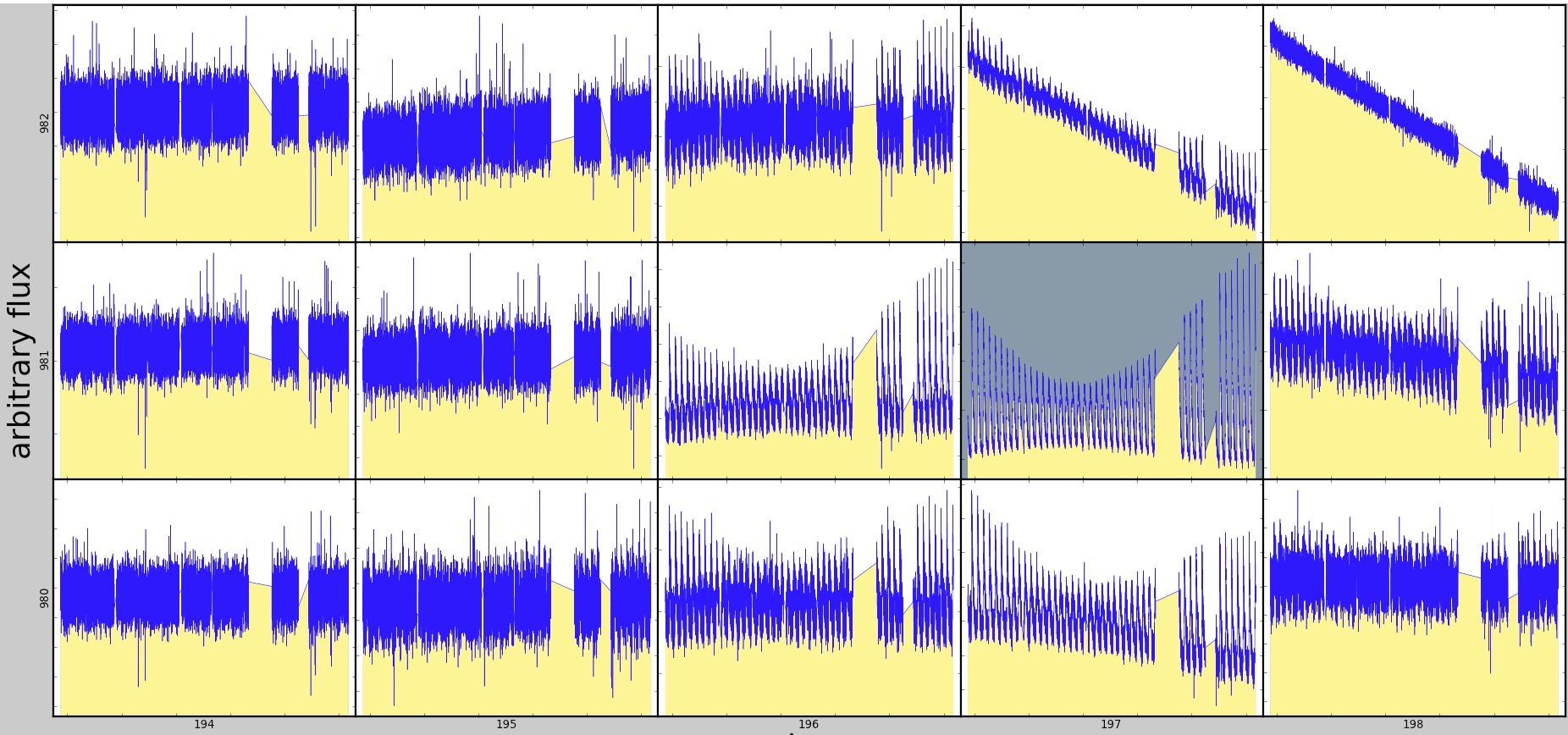
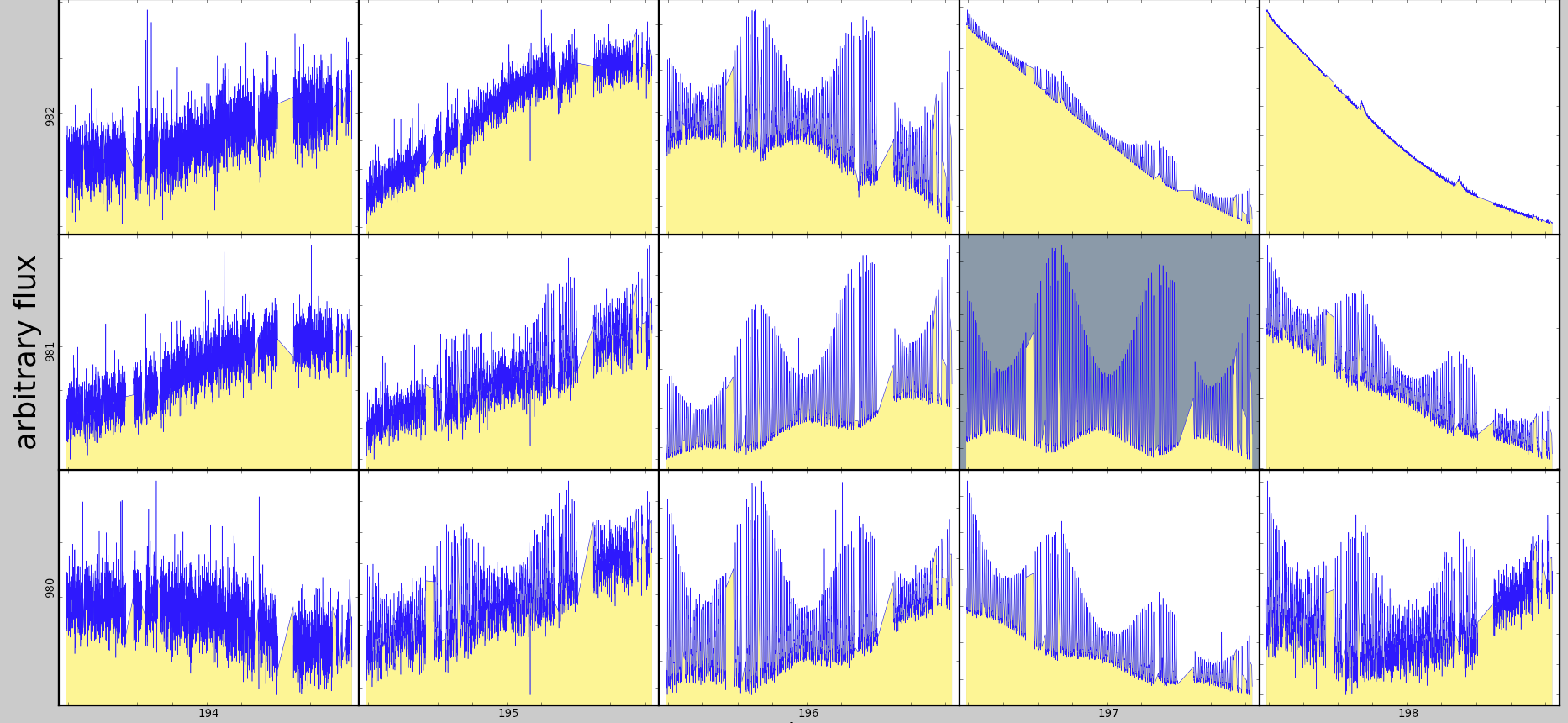
KIC 34487- The Kepler current release data for quarters 12 and 13 shows Blahzko modulations in the time plot.

A 1901 Astrophysical Journal paper by Pickering provides a list of sixty four new variables, one of which — a star in the constellation Lyra — was found using the method above on a plate from July 13, 1899. Examination of this plate by one of Pickering’s staff, Williamina Fleming, revealed a short-period, high amplitude star (aavso.org). In nine years, she (Fleming) catalogued more than 10,000 stars. During her work, she discovered 59 gaseous nebulae, over 310 variable stars, and 10 novae. In 1907, she published a list of 222 variable stars she had discovered (wikipedia).
RR Lyrae variables are periodic variable stars, commonly found in globular clusters, and often used as standard candles to measure galactic distances.” It is roughly estimated that out of the 200 billion stars in our Milky Way galaxy only 85,000 may be RR Lyrae stars. “They are extensively used in globular cluster studies, and also used to study chemical properties of older stars.” (wikipedia) More on RR Lyrae stars at earthsky.org.
The Kepler spacecraft is monitoring a section of our galaxy that consists of approximately 150,000 stars. In a science paper J.M. Benkő et al dated 22 July 2010, the Kepler science team has identified only 29 of them as RR Lyrae stars, and of those only 14 exhibit Blazhko modulations.

It now appears that Planet Hunters has found another RR Lyrae star with Blazhko modulation making a total of 15 with Blazhko modulation.

Q12/13 phased curve for KIC 3448777


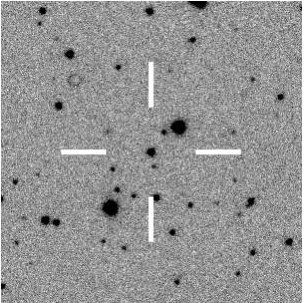
UKIRT image of KIC 3448777 at center


Daryll LaCourse:
That is one heck of a light curve! Below are the Short and Long cadence masks taken from the target pixel files for Q12. Looks like they went with a single-pixel optimal aperture centered around coordinate y981x197:
SC

Full View

LC

 Full View


KIC 3448777 is an unlisted RR Lyrae type ab star that was first identified indirectly by Planet Hunters forum Talk member Thomas Lee Jacobs in the second quarter of 2011 as a nearby contaminator of the light curve for KIC  3448787 shown below:


The phased curve for the contaminated light curve displayed the characteristics for a RRL star which was further analyzed and confirmed by forum Talk member and co-discoverer Kian Jek. Here are some excerpts from the forum Talk thread:

Tom128 (Thomas Lee Jacobs)
Reminds one of an RR Lyrae pattern. Not listed if it is.


Default_user 

about 1 year ago
kianjin (Kian Jek)
Amplitude is too low to be an RR Lyrae type AB, but could be an RRL type C. Right spectral class. Ragged nature of light curve however casts some doubt and suggests possible contamination but background field looks clear.

UPDATE: Oh - I know why the light curve is so crappy and not because of contamination - Q2 was imaged by mod.out 2.3 and therefore a victim of the #fp16 glitch!

Default_user
about 1 year ago
Tom128
Very interesting Kianjin. Does that mean the RR Lyrae-like pattern is a product of the glitch as well ?

Default_user
about 1 year ago
kianjin
No, I was pretty sure the RRL pattern is in the star itself, just masked by errors in photometry and/or postprocessing. Here's how the undetrended but Kepler processed light curve looks like, Q1 to Q3:


It's strange that Q1 doesn't show any pulsations. Q2 is definitely distorted by the fp16 problem, but even Q3 has some funky distortions of its own.
So what I did was to take the raw flux from Q3 alone, detrended it myself and here's what I got - an RRL-like light curve complete with Blazhko modulation!


I'm pretty sure this is what the star should look like, and here's the final phased waveform:


I would wager a guess that it's an RR Lyrae type C. That's because the amplitude of the pulsations is less than 1%, although it has all the other characteristics, spectral class, Blazhko modulation of typical RR Lyraes.
So in the end, you were right, Tom, well done, and a great find!

Default_user
about 1 year ago
Tom128
Outstanding analysis Kianjin and we netted an unlisted one as well! KID 3448787
Default_user
about 1 year ago
zookeeper (moderator) (Chris Linttot)

Just a quick note to say I've emailed a friend who is one of the authors on the Blenko list : http://arxiv.org/abs/1007.3928 - I'll report back if I get any response.

Default_user
about 1 year ago
zookeeper (moderator)
Good news! I've heard back from our friends in the Kepler team, and this star is interesting and indeed new to them, so this is another #discovery for Planet Hunters! Congratulations, Tom128 for spotting it, and Klanjin for the analysis. They're going to do a detailed analysis - indeed, they've already started - and keep us informed. Obviously if it makes a paper then full credit will go to you two.

Some extra details; the reason that the variation appears and disappears between quarters might be because it's a background star; this would explain the small amplitude and if the processing used on different quarters included different parts of the image then that would explain why it comes and goes.
They also say "Any new RRLs - especially the modulated ones - are of great value and very much appreciated! Kepler provides excellent light curves and delivers surprising new discoveries on #RRLyrae stars." so do tag anything you find.

As Robert Szabo, one of the scientists says : 'Congratulations to this precious discovery'.

You can follow this star on the forum Talk thread here.

Sunday, October 21, 2012

The Sound of PH1's Light Curve


 Planet Hunters Q2 Kepler light curve for eclipsing binary KIC 4862625
 that PH1 is transiting.  

 Edit: You can listen to PH1 sonification here.


Forum Talk member TroyW put together a sonfication of the Kepler light curve for KIC 4862625 (quarters 1-9) that the new circumbinary planet- PH1 is transiting through. This is what the light curve sounds like. You can hear the light drops. Though harder to discern, PH1 may possibly be heard just after the main eclipse drop, but before the secondary eclipse- two short audible tweets for PH1 and the secondary. The cricket- like sounds in the background are star variability.

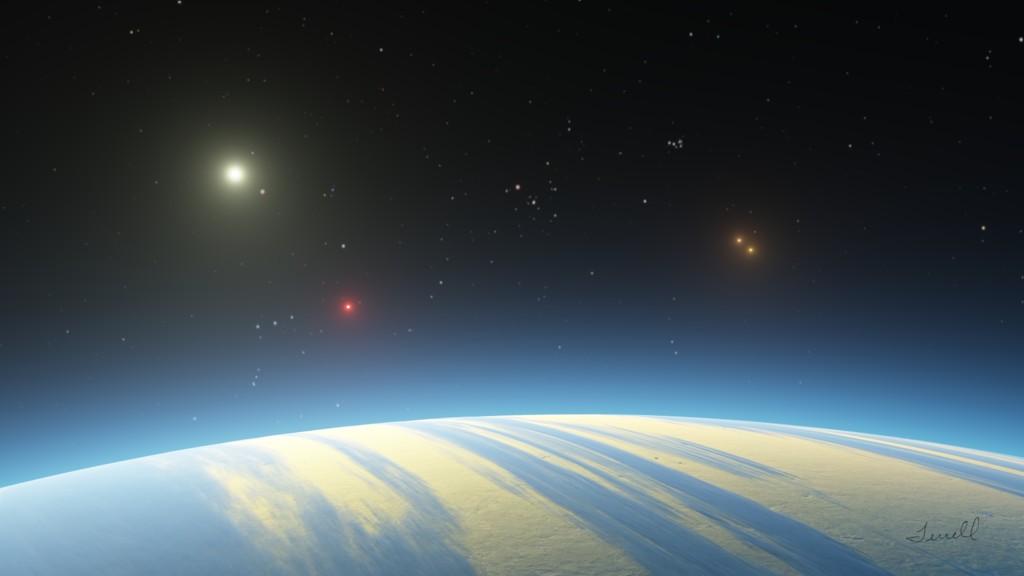
     Artist's conception of PH1 copyright Dirk Terrell 2012


Troy is the developer of the Amateur Kepler Observatory (AKO) and he posts his finds on Planet Hunters forum Talk. 


An Automated Search for Transiting Exocomets- HD 182952 (KIC 8027456)

A team of astronomers led by Grant M. Kennedy , discovered a potential third comet system in the Kepler prime field data of HD 182952 (KIC...