Wednesday, March 19, 2014

KIC 5871088 Possible Long Period Unlisted Saturn Size Planet

Planet transit in Q16 for KIC 5871088 at Planet Hunters

Planet Hunters forum Talk member Clue4fun4 flagged this transit drop in Kepler Quarter 16. It is a very long period planet that has shown up at the tail end of the Kepler data stream prior to the spacecraft going offline in 2013.

Comments by Kian Jek:
This is a very long duration transit that sneaked into the last days of Q16. Eyeballing it, the duration suggests a long period. The primary is a Type K subgiant.
Running a transit fit yields the following:


 The period is very long, from 4.4 to 7.7 yr. The planet is approximately the size of Saturn, at 8.11x RE, based on a stellar radius of 0.882x Sol.


You can follow this planet at Planet Hunters forum Talk page here.

Thursday, March 6, 2014

Japanese Science Team Confirms Planet Hunters Background Dwarf Nova for KIC 11412044

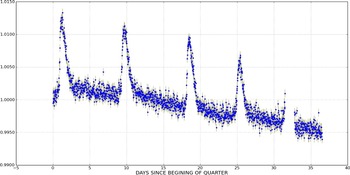
Planet Hunters Kepler Q5 light curve for KIC 11412044

Planet Hunters forum Talk member danasibogdan3 flagged this interesting light curve in Kepler Quarter Five that was later suspected by veteran members to be contaminated by a background  dwarf nova . We posted an article on the possible dwarf nova at this site on July 24, 2012. 

Japanese astronomers Taichi Kato and Yoji Osaki were alerted via our blog article:
"As mentioned in the acknowledgement of the paper, the paper
is based on your discovery of a new dwarf nova in the Kepler
field of KIC 11412044, which we have come to know from your
web page:
http://keplerlightcurves.blogspot.jp/2012/07/dwarf-novae-candidates-at-planet.html "
 They recently wrote a science paper that was accepted by Publications of the Astronomical Society of Japan (PASJ)  that you can view here.

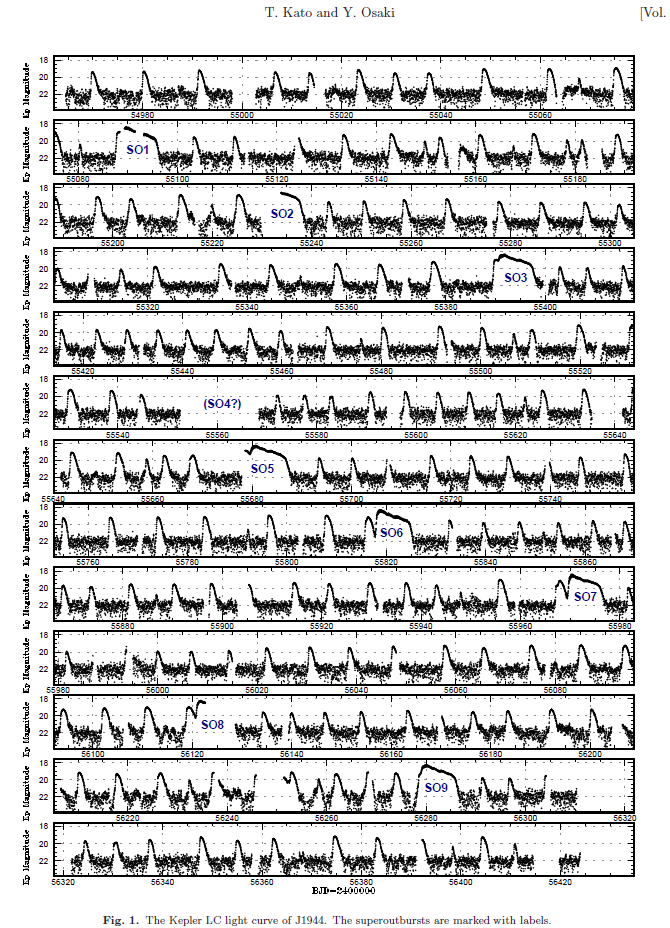
Light Curve for KIC 11412044 by Taichi Kato and Yoji Osaki
" The object is astrophysically very interesting as it has an extremely short orbital period and high outburst activity. "  
"We studied one of these background dwarf novae, the one in the field of KIC 11412044 (hereafter J1944). This object was discovered by the Planet Hunters group as a
background SU UMa-type dwarf nova of KIC 11412044, in which superoutbursts and frequent normal outbursts were recognized. 2 Since it was bright enough and it was
frequently included in the aperture mask of KIC 11412044, the outburst behavior can be immediately recognized in Kepler SAP FLUX light curve of KIC 11412044."
 "At this location, there is a GALEX (Martin et al. 2005) ultraviolet source GALEX J194419.33+491257.0 [NUV magnitude 21.3(3)] and we identified this source
as the UV counterpart of this dwarf nova (figure 3, Q16), confirming the suggestion in the Planet Hunters’ page. The superhump component and 0.0528 d component were
also confirmed at the location of this object (figure 3, Q14), and we consider that the 0.0528 d signal indeed comes from this dwarf nova."


Saturday, February 22, 2014

KIC 8016431 Possible Unlisted Planet Candidate

KIC 8016431 in Kepler Q7 at Planet Hunters

Planet Hunters forum Talk member Tesh90 flagged this possible unlisted planet candidate transit in the Kepler Q7 light curve. A second transit was identified near BJD 1420.2  along with transit analysis by Hans Martin (Zoo3hans).

Comments by Planet Hunters forum Talk member Kian Jek: 


Here is the TAP run:


The transit curve fit:


The transit depth is 933 ppm with a duration of 15.07 hr. In order to make the orbital parameters consistent with the stellar data at MAST, I find that I get a better fit if the stellar radius is adjusted up to 0.89x Sol instead of 0.621, and the stellar mass set to 0.95x Sol. This is more reasonable for a 5671K Teff, and makes this closer to a Sol-like star.

If so, then we get a 2.79x (+/- 0.21) RE planet, orbiting at 1.624 (+/- 0.21) AU from the primary. The Teq is approx. 184K.

You can follow the thread on this planet at Planet Hunters forum Talk thread here.

Thursday, February 20, 2014

KIC 9396866 Possible Unlisted Planet Candidate in Habitable Zone

KIC 9396866 Q4 light curve at Planet Hunters

Planet Hunters forum Talk member Scienceweb flagged this possible unlisted planet candidate transit in the Kepler Q4 light curve. A second transit was identified near BJD 1342.5 along with transit analysis by Hans Martin (Zoo3hans).

Comments by Planet Hunters forum Talk member Kian Jek:

Here are the results of running a Mandel-Agol fit on the 2 transits.


From the fitted curve the depth is 290 ppm and duration is 25.2 hrs. The goodness of fit parameter, R2 is reasonable, at 0.59, and isn't too bad, given the circumstances. Since this is a Kp=12.59 star, the quality of the light curve could have been better, but even so, a 290 ppm transit does stand out quite clearly.
The problem is that MAST does not have stellar parameters for this star, but since we know the period, depth, duration and the Rp/R* and a/R* values derived from the transit fit we can make some guesses.The stellar primary is ~1.67x Sol and mass of ~1.23x Sol. The planetary radius is 2.98 (+/- 0.16) RE, orbiting at a distance of ~2 AU. The Teff of the star is not known, but an averaged guesstimate from the gr, J-K and G-K values gives something around 6000K. If so, then this is a possible HZ planet with a Teq of 236K. A little chilly, but this is actually warmer than Mars.
You can read more about this transit at Planet Hunters forum Talk here

Saturday, February 8, 2014

KIC 7105691 Unlisted Detached Eclipsing Binary with Highly Eccentric Orbit

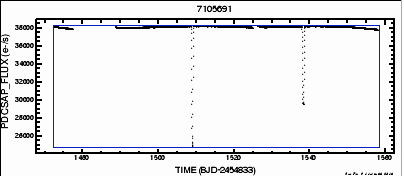
KIC 7105691 in Q16 at NEA

Planet Hunters Talk member  Blammo flagged this star in Q16. It is part of an unlisted detached eclipsing binary star system that has now shown up for the first time in sixteen quarters of the Kepler light curves. The reason is that it has a highly eccentric orbit. Here is what PH forumTalk member Kian Jek has to say:
This is a very eccentric eclipsing binary for sure, but is it the real EB? An examination of the FITS file shows tiny APOs:

However, the vector plotted out shows the flux centroid shifting towards the tiny unmarked star at 1 o'clock. What I think is happening here is that during the dimming of the target, the presence of the companion in the halo pixel is shifting the centroid towards itself.


Let's try and calculate the eccentricity of this EB. I use the following relation, found in p. 86 of Kallrath and Milone (2009) to determine the minimum eccentricity of this EB:

where P is the period, t1, t2 are the epochs of the primary and secondary eclipses, in this case, for delta t1,t2, we have 29.8d as the separation between these 2 eclipses. P is not known, but we can assume that it is >1386d. Entering these values into the equation, we get a minimum eccentricity of 0.75.
This is quite an eccentric orbit, but it is not the most extreme eccentricity for an EB in the Kepler data set. That honor belongs to KIC 9214712, which has an e_min of 0.85 (see Dong et al)

You can read more about this star at the PH Talk thread here.


Saturday, January 25, 2014

KIC 8570781 Unlisted EB in Q16

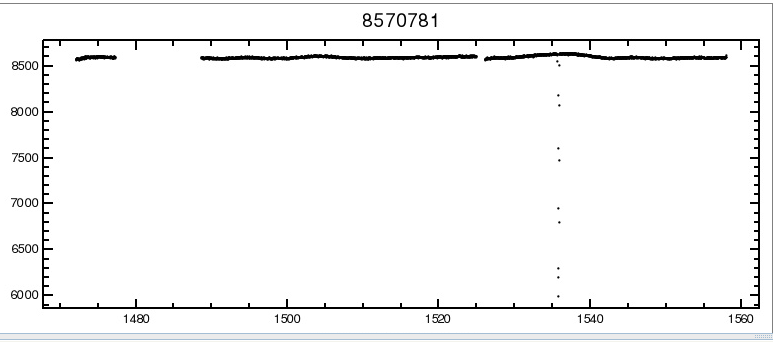
NEA Q16 Light Curve for  KIC 8570781

This Q16 light curve shows a long period detached eclipsing binary transit for KIC 8570781. Unfortunately, with the Kepler spacecraft no longer in operation, we will not be able to determine the EB's period. 

You can view the thread at Planet Hunters forum Talk page here.


Unlisted RR Lyrae type C - KIC 10988601 contaminating KIC 10988583

Light Curve for KIC 10988583 contaminated by RRL type C KIC 10988601 by Kian Jek

Planet Hunters forum Talk member Mike Barrett (mjtbarrett) posted an interesting LC for KIC 10988583 that has a phased curve indicative of a RRL type C. With forum Talk members assistance, the actual RRL type C was narrowed down in the Kepler field of view to star  KIC 10988601.


Kian Jek's comments:

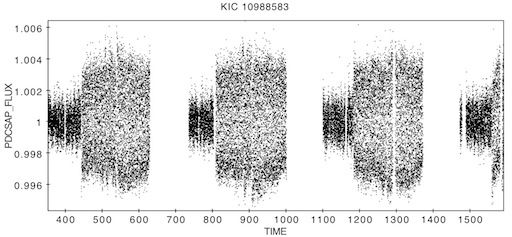
The phased curve certainly does have RRc characteristics but the amplitude is off. An inspection of the entire light curve tells us straight away that this is contaminated flux:


But where is it coming from? Looking at the Q6 TPF, it is clear that the contamination is in the halo pixels vertically below the target pixels.


There are in-phase APOs as well:


To cut a long story short, here's the phased curve from that one halo pixel in Q6, col 102 row 899, normalized and it now does match the amplitude and period of a typical RRc variable:


From the TPF, and the APO vector, it appears that the contaminating RRc is KIC 10988601, #2 in the Skyview image:


Even though 601 is more than 10 arcseconds away from the target, after re-orientation, it is directly below and one pixel to the left of the target. It is very likely there is a charge bleed along the column indicated since it is brighter than the target, causing it to contaminate that halo pixel. A quick check of the MAST parameters for KIC 10988601 tells us that it has a Teff of 7169K (F0/A9) and an estimated stellar radius of 2.287, almost exactly what we need for an RRc pulsator.
You can read more about this star on the Planet Hunters forum Talk thread here.

An Automated Search for Transiting Exocomets- HD 182952 (KIC 8027456)

A team of astronomers led by Grant M. Kennedy , discovered a potential third comet system in the Kepler prime field data of HD 182952 (KIC...