Sunday, September 2, 2012

Disappearing Eclipsing Binary Stars - Evolving Orbits

The strange story of the disappearing eclipsing binary star systems begins with forum Talk members troyw and Kian Jek's comments on KIC 7955301. Here is what Troy had to say:

KIC  7955301 was added by request to AKO (Amateur Kepler Observatory) and also referenced here in another TTV/EB thread. An incredible image is produced for this star. ~15.34 days you can see the primary eclipses, secondary eclipses, TTVs and an evolving orbit all in one. Have a look at the TTVs in particular. You can see how the sine wave nature of the primary and secondary eclipses are slightly offset. I thought a secondary eclipse would show either the same phase of sine wave, or 180 degrees out of phase. This seems to be out of phase by 15 or 20 degrees. Not only that, but there is trend in primary eclipse line that is different than the secondary. I am not sure how to describe it, other than overall angle of the primary transit line is different than the overall angle of the secondary eclipse transit line.


The blue lines show the difference in transit line angles. Is this an effect of the evolving orbit? Or a larger TTV mixed with the smaller ones? Here is the star on AKO, lined up to 15.34
http://www.extrasolar.us/AKO/Kepler.php?KID=7955301&period=15.34

Here are Kian Jek's comments:

I had meant to take a good look at this star for some time now ever since it was mentioned in Slawson et al:
At the time of this writing, about half of the sample has been completed. The O-C diagrams were inspected visually, and eight cases where the O-C diagram has a significant signal through Q2 were identified, see Figs. 4 and 5. KID5771589 and KID7955301 have changes in their O-C diagrams of more than 100 minutes. Most of the others have changes of 20 to 40 minutes. It seems unlikely that such large changes in the O-C diagram over such short times (≈ 125 days) can be caused only by light travel time effects. We also note that the timescale for apsidal motion is much longer than the variations seen here. Hence, each of these EBs is most likely interacting with a third body.
As we now have up to Q11 data for this star, the change is much greater than 100 minutes. But there are more interesting things here. A plot of the combined light curve shows that the orbit is evolving in inclination:


The red and blue dots mark the extrema of the primary and secondary eclipses respectively, and curves fitted. The curve-fits seem to indicate that the eclipse depths could have maxed out and perhaps in future quarters we might see the depths recede again? A phased plot of the detrended light curve using Prsa v3's period of 15.32634, shows a clean fold:


It's when you zoom into the primary and secondary eclipses that you see the effect of TTVs clearly:


An O-C plot made of the primary and secondary eclipses show very regular periodicities, the red plots are the primary eclipses and the blue, the secondary eclipses:


Here are curve fits to both of them:


The primary eclipse O-C was fitted with a sine curve.


For the secondary eclipses, a cubic-spline fit does a better job. There is a kink just past each local maxima. a similar kink can also be seen in the primary eclipse O-C.


 Now on to KIC 5771589:

Comment by troyw:

Yet another beauty of a system full of TTVs, transit depth variations and mystery! These two transit lines are in phase with each other for the smaller transit shifts, but seems to show a much larger trend of being out of phase. (The primary transit line angles slightly down from left to right, and the secondary transit line angles slightly up from left to right.)


Kian Jek's comments:
This is a very interesting system. There are no APOs, the shallowness of the eclipses are due to the low inclination of the plane of the orbit of the two stars, resulting in grazing, partial eclipses. However, there's much more. I detrended the entire LC and what emerges appears to be decreasing eclipse depths. This suggests an evolving orbit with the inclination changing with time:


In fact, if one extrapolates the slope of the eclipse line, we find that the eclipses may well disappear by Q12, 346 days away!

There are obvious TTVs (or ETVs if one wants to be pedantic) - if I take the published period and fold the LC to see the primary and secondary eclipses, here's what you get:


There appears to be something perturbing the orbits of the components of this eclipsing binary. Perhaps a third stellar object, fairly massive but not in our line of sight.Plotted the O-C for the secondary eclipses, overlaid on the O-C for the primary eclipses. The Secondary O-C is skewed, but has the same periodicity as the primary.


If the precession of the plane of the orbits is due to a third body, the shape of the evolution of the eclipse depths may not not be linear but follow a sinusoidal curve. The eclipses may not disappear, but instead decrease to a minimum and then start increasing again. Or something like that.

troyw:
 
Will this star system continue on its course and complete a disappearing act?
Or.. will a hidden body fling this dancing duo back into the spot light for another chance to be seen?!

Tune in next quarter. Same bat time. Same bat channel.


  KIC 10319590 by Kian Jek:
First mentioned in Slawson et al, KIC 10319590 was noted to have ETVs in excess of 20 minutes. But that was many quarters ago and the data they had was from Q0 to Q2. So out of curiosity I downloaded the light curve and took a look and this is what I found:
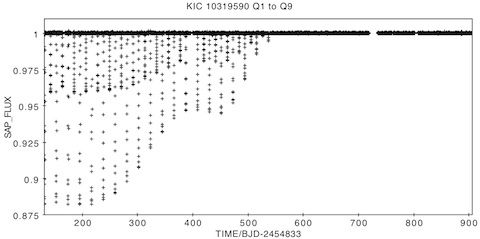

Not only is this an evolving orbit, but what's remarkable is that due to precession it is changing in inclination at different rates, including bursts of rapid change, so by the middle of Q6, the two stars finally left our line of sight and stopped eclipsing each other. The O-C plot shows interesting periodicities that appear to be correlated with these inclination changes - the inclination (and eclipse depth) changes faster when the ETVs (Eclipsing Timing Variations) appear greatest:

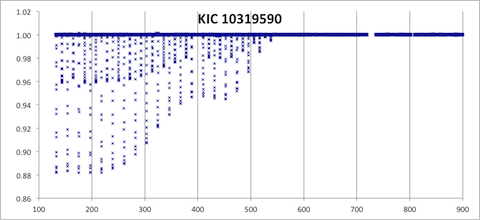

The period of the ETV variation is approximately 383 days. Will the eclipses reappear? If I'm assuming that the precession will lead to a complete rotation of the plane of the orbit, then yes. But when? A simple model of this system shows that with a period of 21.3d, the separation and relative sizes of the two stars will cause it to disappear from line of sight at an inclination of 87.5°. Since we are not sure what the inclination was at the start of the observed light curve, let us assume that it starts at 90°. So the rate of the precession will be roughly 2.5° every 400 days.
The plane of the orbit will have to return to 87.5° in the opposite direction for eclipses to reappear, i.e. it will have to rotate 175°. So 175/2.5 = 70 * 400 = 28000 days or approximately 76.6 years. Also, 400 days is a lower bound, so it's probably longer than that. I don't think we'll be around to see the eclipses reappear unfortunately. However, since the orbit of the third object is also being perturbed by presence of the close binary, it's possible that at some point its own precession will bring it into eclipse with one or the other of the binary stars.

https://mail-attachment.googleusercontent.com/attachment/?ui=2&ik=cfdaccf8d8&view=att&th=1398cf0f1fcbe7d9&attid=0.1&disp=inline&safe=1&zw&saduie=AG9B_P_fWMyEwvqJy97TrUk5AsN8&sadet=1347075588104&sads=7CIYuju9ZUtrXw7LPiyupSzCI7Q

Did you read that correctly? An eclipse return date of approximately 76.6 years!


And finally KIC 5653126, the reappearing eclipsing binary star system:

Kian Jek:

I thought I'd just download the new Q7-9 data for 5653126 to see how it's turning out and just as Robin said, secondary eclipses have started appearing in Q8 - the inclination of the eccentric orbit has continued to shift so the secondary is finally being occulted by the primary:


Updated O-C plot for the eclipses. The blue plots are the newly visible secondary eclipses:


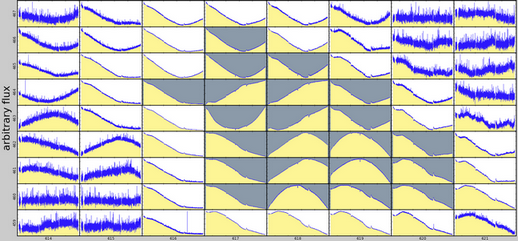
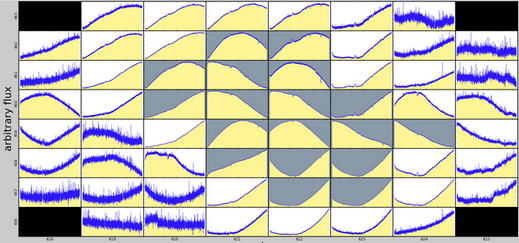
trow's AKO graph (left column on Kian Jek's chart:


 You can track these stars at the Planet Hunters Talk thread here, here, here and here.

Saturday, September 1, 2012

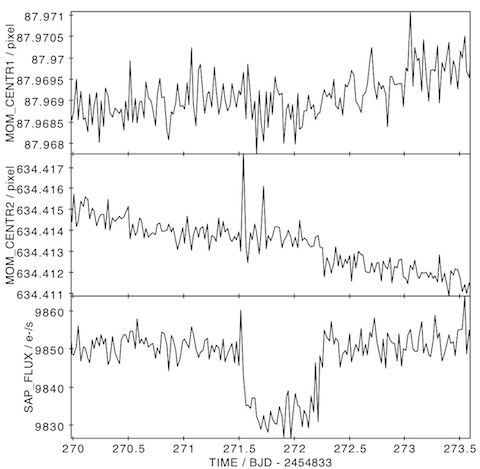
Unlisted Planet Candidate KIC 8636333

This is the first transit in quarter three of the Kepler data in 2011. Here is forum Talk member zoo3hans' comment:
This could be a 3.9 R_Earth planet @ 2.4 AU from its star with an estimated period of 1435 days and T = 152 K.

Kian Jek's comment:
 Looks clean to me, no APOs detected in the FITS file.


You can follow this planet candidate here.

Thursday, August 30, 2012

KIC10024862 - 600 day Eclipsing Binary or Planet?

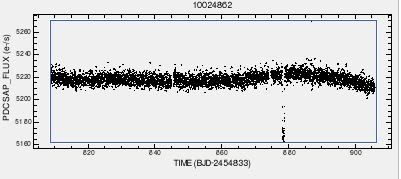
This transit occurred in the fourth quarter of the Kepler data release in 2011. Now in Q9, another significant drop has occurred.


Here is the analysis from forum Talk member Kian Jek:
Very nice 17hr drop. Could be a 0.84x RJ planet from the transit profile. However, the Q4 transit appears to have a similar duration, so it's possible that this is a long period, P > 600d, EB and with the secondary eclipse in Q4 and the primary in Q9.

More information here and here.

Saturday, August 25, 2012

The Nine PlanetHunters Habitable Zone Candidates


There has been lots of exciting news about alien worlds recently with the announcement of confirmation studies for over 41 Kepler exoplanets across 20 star systems, and in addition the fourth circumbinary system in the form of Kepler-38b. It seems not a day goes by anymore without at least one interesting exoplanet related pre-print hitting ArXiv.org--usually it is several!

The Kepler deluge is perhaps a double edged sword in that the KOI list is ever expanding as the mission proceeds through each Quarter, greatly outpacing the expansion of the confirmed candidate family and surely making it an excruciating process for science teams to decide which targets to allot precious follow-up resources on.

Some of the most lucrative candidates include those where early characterization suggests the exoplanet may reside squarely inside or on the periphery of the Habitable Zone of its host star: these are the potential crown jewel discoveries in an extended Kepler mission and I believe around ~46 such targets are currently listed, with Kepler-22b being the first such confirmed.

A round up of targets from PH not included on the current KOI list which may also possess HZ orbits (based on analysis of their transits c/t predetermined host star parameters) could potentially add a further nine systems. Further spectroscopic investigation is needed to rule out the possibility of blends, but the group seems relatively free of offsets and all possess good looking transits. While none approach the size of a true Earth analog, everything we're learning about the possibilities for exotic life in the Universe still renders them very interesting candidates, especially if considering that many of these bodies may be prone to possession of small to medium size exomoons. No exomoons have been confirmed yet in any system, but currently thirty habitable candidates are predicted on the lists over at the Habitable Exoplanets Catalog!

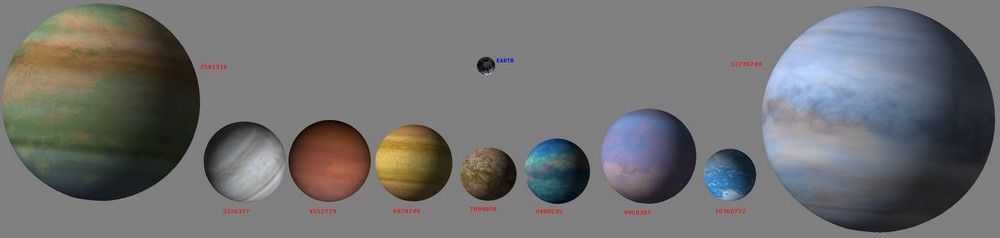
Additional caveats applicable to the derived impact parameters for the list below: an assumed albedo of 0.3 was used in most cases and the exact planetary mass, eccentricity and atmospheric compositions are not known at this time (the colors and features shown in banner image were chosen rather arbitrarily). Further ambiguity in the accuracy of the KIC parameters for the host star, or dilution from nearby sources, could also dramatically throw off the assumed effective temperatures and radius values.

KIC 4552729

Of the nine targets this is the only one that has received any real follow up so far and was one of two exoplanets discussed in the second PlanetHunters paper by Lintott, et al from February, 2012. The orbital period is 97.46 days and a best fit seems to indicate a planetary radius of 4.65Re, however the presence of an incomplete Transit Timing Variation cycle and some variation in the depths precludes full confirmation at this time, leaving 4552729 in the candidate realm until a background eclipsing binary can be wholly ruled out.

Source

KIC 6878240

Found around a type K dwarf star smaller than the Sun and appears in Q2, Q4 and Q5 with a period of 135.5 days. Object is thought to be around 4.1Re with a possible Teq of 246K.

Source

KIC 7899070

Transits are seen throughout the public data set. Assuming the host star has a radius of .49x Sol, this could be a 3.0Re exoplanet orbiting at the equivalent of .43AU and possessing a Teq of 254K. The long transit duration could be explained by eccentricity or error in the listed KIC value for the host star radius.

Source

KIC 9480535

With several transits visible and a 13.25 hour duration, this could be a 3.5Re exoplanet orbiting the type G host star at a distance of .57AU and a period of 160 days. The assumed Teq is 327K.

Source

KIC 10360722

This is the smallest candidate on the list with a potential radius of 2.7Re, however there is some concern that a background binary could be interfering with the light curve and further follow up is needed. Assumed period is 163 days, at a distance of .43AU and a Teq of 296K; the host star is Type K.

Source

KIC 12735740

Only two transits in the public data thus far, but they look clean and decidedly unlike an EB profile. Also by far the largest candidate on the list with an assumed radius of ~12.0Re (or 1.12Rj). The host star is a 12.6Kmag type G dwarf and the characterization suggest a 282.5 day orbit at .86AU and possible Teq of 292K!

Source

KIC 3326377

This is an interesting potential multi-candidate system that seems to have a possible 'Super-Mercury' exoplanet at a short period of 13 days and then a second candidate much further out at .65AU and a period of 198 days. Uncertainties exist with the host star parameters, but the second candidate could exist in a minimum of the Super-Earth radius domain (2.84Re to 4.4Re) and may lie just outside the HZ possessing a Teq of 225K. *Edit: This co-discovery candidate is also described at the official PlanetHunters blog, found here.
KIC 9958387

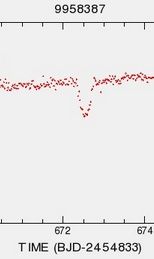
The subject of my last blog post and a recent HZ addition to the PlanetHunters list, displaying three very nice transits, with the latter visible in public Quarter 7 data. This candidate has a period of 236.7 days and an assumed radius of 5.1Re with Teq of 325 - 332K.

Source

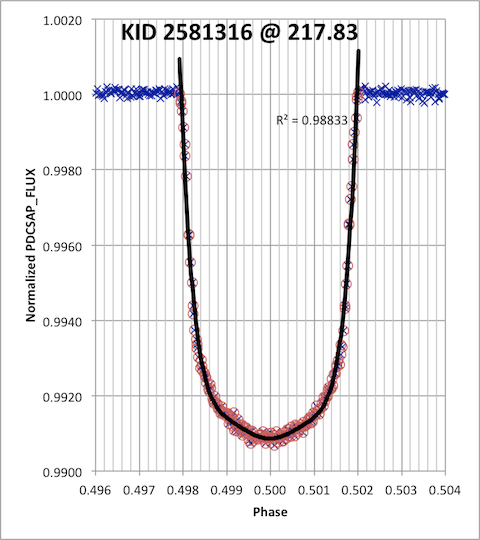
KIC 2581316

This final entry in the list bears some significant uncertainty and was the subject of another blog post by Tom Jacobs after analysis was renewed on it several weeks ago. It appears to have been associated at one time with the official Kepler False Positive list, although it does not appear there now. The KIC still lists "Unknown" for the host star values of stellar type, temperature and solar radius, however the 217 day period transits are quite good for an 11.7 Kmag target and no significant offsets appear to be involved. If we assume that the host star is a Type G with Teff of ~5200K and solar radius equivalent to or just short of Sol, this could put the candidate inside the habitable zone at .68-.71AU and rough Teq of ~265K. The assumed radius is 10.5Re or .84Rj, making it a large exoplanet in any case and similar in domain to the candidate suspected at KIC 12735740.

Source


Various further reading and links of interest:

The Habitable Exoplanets Catalog @ PHL
Kepler: The Long Road to Other Worlds
How to Find a Habitable Planet -  Kasting
How to Build a Habitable Planet - Broecker & Langmuir
IAU 293: Formation, Detection and Characterization of Extrasolar Habitable Planets (upcoming)
What We're Looking for in the Perfect Exoplanet

Transit plots courtesy of Kian Jek. Comparison banner graphic created using Sphere-Builder app.
-----------------


In respectful memory of Neil Armstrong, who inspired us all to explore Strange New Worlds


Monday, August 20, 2012

KIC 2581316 - Unlisted Planet Candidate or Eclipsing Binary?


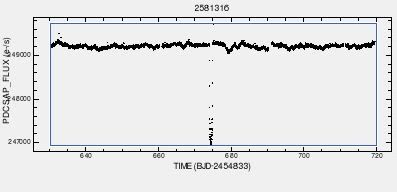
Planet Hunters forum Talk members flagged this transit for KIC 2581316 around May of 2011. There are now four observed transits through quarter 9 in the released Kepler data set. It appears that this transit was originally flagged as a false positive, but no longer appears on that list. The star has a magnitude of 11.69.

Q9 time plot


Here is Kian Jek's comment:
"From the profile it looks like a classic planetary transit, and may not be an EB after all - rapid drop offs, with a clustering of data points at a U-shaped bottom. Unfortunately we don't know the radius of the star."

Here is Daryll Lacourse's comment on Keppixseries below:
"July released target pixel files for KIC 2581316; the transits/eclipses seem visible and included within the large optimal aperture masks in each case. Contamination does not seem to be involved."


Full view


 Full view

Visit the Planet Hunters forum Talk page for more information on this transit here.


Sunday, August 19, 2012

A New Potential Habitable Zone Exo for Kepler


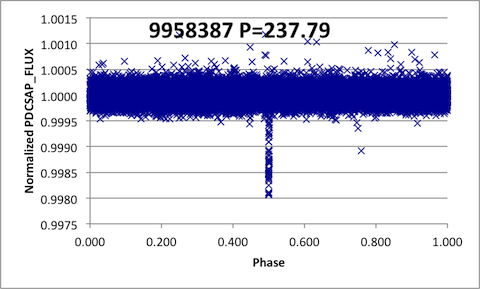
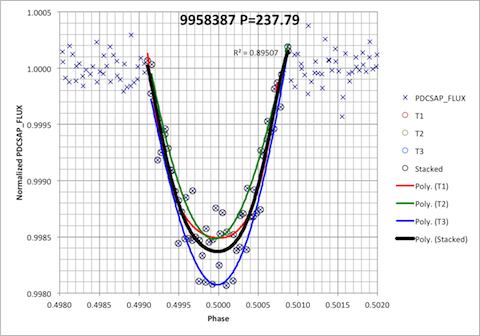
The preliminary characterization of another long period exoplanet within the Habitable Zone of its host star has become possible recently by way of a third transit spotted in public Quarter 7 data, around target KIC 9958387.

This star is listed in the KIC catalog as a main sequence spectral type F just slightly larger than our own Sun, with a temperature of 6159(K) and an apparent visual magnitude of 13.5. The transits for this candidate were noted during manual searches by PH users and display a period of  237 days (with Transits 1 and 2 occurring in Quarter 2 and 4, respectively), if the aforementioned KIC values are accurate then combining them with the observed depth and duration should correspond to a body of roughly 5 times Earth radius and a Teq of 325 to 332K!


Significant pixel offsets that might indicate a contaminating eclipsing binary do not seem readily apparent here and lend some more weight to this initial characterization, although further follow up is of course required.

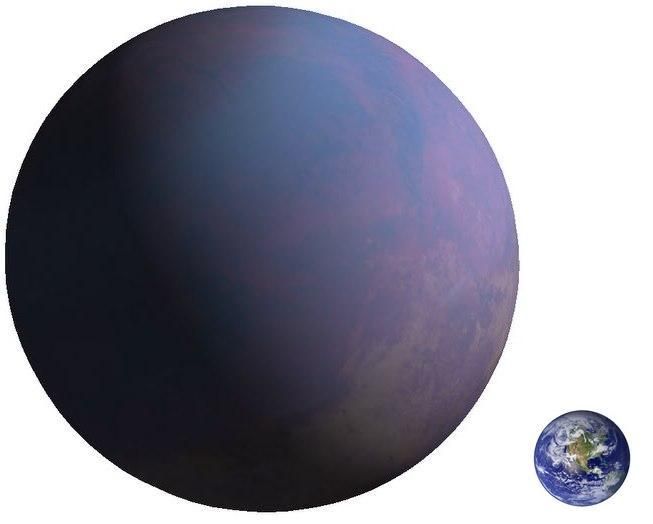
With a possible radius of ~32 000km, this exoplanet certainly would not resemble Earth despite being at a comfortable distance from the F star; any rocky core is likely well swathed with a thick envelope of gases that could come in a wide range of compositions. But considering the potential HZ orbit, it's interesting to speculate if significant H20, organic molecules and other basics required by the sort of prokaryotes and extremophiles we recognize may be present there--or if there are also any accompanying exomoons!

This is a crude scale approximation to Earth below; the atmospheric colors and distribution are randomly generated.


Graphics courtesy of NEA, Sphere Builder & Kian Jek

Kepler Unlisted Gamma Doradus Star Collection


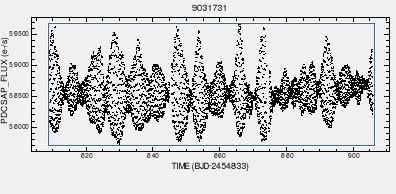
Planet Hunters forum Talk members have assembled an evolving Kepler "Data Mining" list of unlisted and known Gamma Doradus (GDOR) variable stars like KIC 8364249 above. You can check out the 26 page and counting, collection here.

KIC 9031731 at quarter 9.


This is a pattern recognition list and many of the entries may fail as GDOR stars after further analysis. The list may also provide some exotic stars not currently classified. Consider this thread to be a working list of eligible stars that visually look like GDORs. Members, with the expertise, can later pull interesting stars from the list for further investigation.

From our good friend wikipedia: "Gamma Doradus variables are stars which display variations in luminosity due to non-radial pulsations of their surface. The stars are typically young, early spectral F or A type main sequence stars, and typical brightness fluctuations are 0.1 magnitudes with periods on the order of one day. This is a relatively new class of variable stars, having been first characterized in the second half of the 1990s, and details on the underlying physical cause of the variations remains under investigation. The prototype is Gamma Doradus."

An Automated Search for Transiting Exocomets- HD 182952 (KIC 8027456)

A team of astronomers led by Grant M. Kennedy , discovered a potential third comet system in the Kepler prime field data of HD 182952 (KIC...