Saturday, January 25, 2014

KIC 8570781 Unlisted EB in Q16

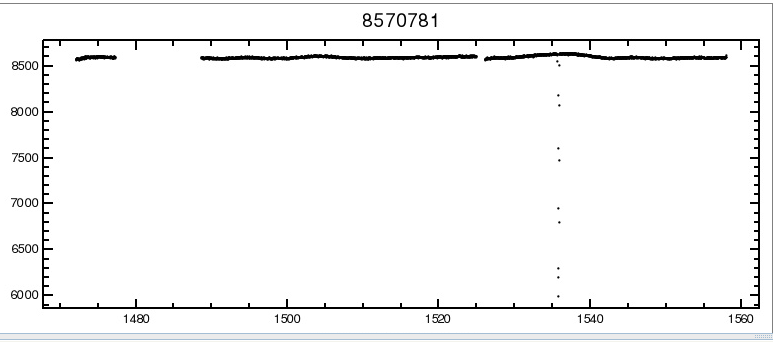
NEA Q16 Light Curve for  KIC 8570781

This Q16 light curve shows a long period detached eclipsing binary transit for KIC 8570781. Unfortunately, with the Kepler spacecraft no longer in operation, we will not be able to determine the EB's period. 

You can view the thread at Planet Hunters forum Talk page here.


Unlisted RR Lyrae type C - KIC 10988601 contaminating KIC 10988583

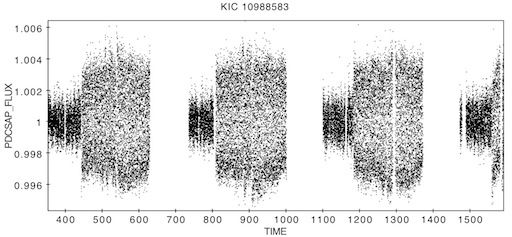
Light Curve for KIC 10988583 contaminated by RRL type C KIC 10988601 by Kian Jek

Planet Hunters forum Talk member Mike Barrett (mjtbarrett) posted an interesting LC for KIC 10988583 that has a phased curve indicative of a RRL type C. With forum Talk members assistance, the actual RRL type C was narrowed down in the Kepler field of view to star  KIC 10988601.


Kian Jek's comments:

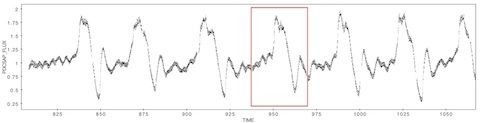
The phased curve certainly does have RRc characteristics but the amplitude is off. An inspection of the entire light curve tells us straight away that this is contaminated flux:


But where is it coming from? Looking at the Q6 TPF, it is clear that the contamination is in the halo pixels vertically below the target pixels.


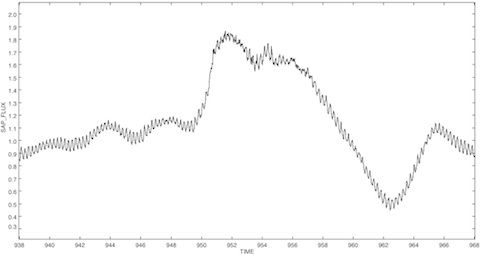
There are in-phase APOs as well:


To cut a long story short, here's the phased curve from that one halo pixel in Q6, col 102 row 899, normalized and it now does match the amplitude and period of a typical RRc variable:


From the TPF, and the APO vector, it appears that the contaminating RRc is KIC 10988601, #2 in the Skyview image:


Even though 601 is more than 10 arcseconds away from the target, after re-orientation, it is directly below and one pixel to the left of the target. It is very likely there is a charge bleed along the column indicated since it is brighter than the target, causing it to contaminate that halo pixel. A quick check of the MAST parameters for KIC 10988601 tells us that it has a Teff of 7169K (F0/A9) and an estimated stellar radius of 2.287, almost exactly what we need for an RRc pulsator.
You can read more about this star on the Planet Hunters forum Talk thread here.

Saturday, June 22, 2013

GDOR-like Patterns and UKIRT Merged Stars

 KIC 10681464 at Planet Hunters

UKIRT image


At Planet Hunters we are good at detecting patterns in the Kepler light curves. So it is not unusual to see some speculation on our more interesting star patterns with visual anomalies. In this case we are posing some questions about Gamma Doradus-like (GDOR) stars with very close in neighbors showing up on UKIRT. Is there a link between possible contamination showing up in the field of view and the actual GDOR-like pattern in the light curve? Are we seeing the effect of a background GDOR as contamination? Or is this simply a random event, coincidence with no relationship?  Taking this speculation one step further, can there be, in some instances, a gravitational link between very close in neighbors showing up in the field of view of those stars that appear to be merging? Can some of the light curve patterns be indicating a binary star system relationship?

Tom128
We are seeing a lot of contaminated stars in the Kepler field of view with GDOR-like LC patterns. Any thoughts as to why? Instead of false positive transit drops we are seeing these interesting contamination patterns.

Here are some examples taken from our PH GDOR list:
KIC 10681464 Listed on VSX as a SPB - http://talk.planethunters.org/objects/APH43125465


UKIRT


KIC 10199218 http://talk.planethunters.org/objects/APH73018369


UKIRT


KIC 5301537 http://talk.planethunters.org/objects/APH72114406


UKIRT


KIC 10728428 http://talk.planethunters.org/objects/APH53074550


UKIRT


KIC 12218729 http://talk.planethunters.org/objects/APH72010654


UKIRT


KIC 2695344 http://talk.planethunters.org/objects/APH73093495

4 months ago
djsimister
@Tom128 Not on our list but maybe Another example?

KID 5728217 http://talk.planethunters.org/objects/APH10027511


UKIRT.

Default_user
4 months ago
Tom128

Yes, it seems instead of false positive transit drops we see these light curve patterns. I did not do any contamination analysis on any of these light curves, but they seem to have the same visual merged or close in neighbor. Here are a some more examples:
KIC 3441414 http://talk.planethunters.org/objects/APH22140442


UKIRT


KIC 4076350 http://talk.planethunters.org/objects/APH52022370


UKIRT


KIC 1295531 http://talk.planethunters.org/objects/APH71094127


UKIRT

Default_user
4 months ago
arvintan

 here's a couple more from my collection:


KID 6782360: http://talk.planethunters.org/objects/APH52098313


KID 5689219: http://talk.planethunters.org/objects/APH10038724
Default_user
4 months ago

Tom128

Here is another example of a GDOR-like LC with a close neighbor on UKIRT:

KIC 5650341


http://talk.planethunters.org/objects/APHE2000oht

UKIRT


You can follow this thread on the Planet Hunters Talk Science board here. 

Monday, May 6, 2013

KIC 5879583 Unlisted RR Lyrae Star


Contaminated Star  KIC 5879574 in Q2 at Planet Hunters

Planet Hunters forum Talk member Tom128 posted the unusual light curve above for KIC 5879574 in Kepler Q2. At that time Kian Jek commented:
Possible #contamination from KID 5879583 (not a Kepler target) but is a nearby A star. RRL lightcurve (on detrend) but class is G.
Unfortunately, the contaminator star was never followed up at Planet Hunters until recently when Talk member Cappella found  KIC 5879583 to have been targeted by Kepler in Q14.

Kian Jek:

If two years ago we'd known how to do the kind of APO/TPF contamination analysis, we'd have fingered the Type A star known then as #5 on the Skyview as the likely RRL Type A, and it would have been the 2nd RRL to be discovered through Kepler LC blending, a testament to the fidelity of Kepler's CCDs.
Here's the LC of the contaminated star, KIC 5879574, the APOs are startling - they are humongous, at nearly 100 millipixels, and you can make out that the contaminant even has Blazhko modulation:


The APO vector points roughly in the direction of our 5879583 - the green arrow is in the direction of flux maxima:


and the TPF (flipped and rotated to N is up, sky orientation) shows that the halo pixels in the same direction are the ones with the RRL modulation:


Saturday, April 13, 2013

Mystery Star KIC 9406652 at Planet Hunters


Q10 Time plot for KIC 9406652 by Kian Jek

Forum Talk member Penn_gwenn flagged this star in Kepler Q2. It immediately attracted interest from forum members, Zoo3hans, Kian Jek, Nighthawk_black, Cappella and others as a possible Dwarf nova or Heartbeat binary. You can see superhump-like features in the time plot above. KIC 9406652 is currently being investigated by the Kepler Guest Observer program for further analysis. No one quite knows what exactly this star is.

Kian Jek

I believe this might be genuine. There are APOs of around 20-30 millipixels in the source FITS file, but the brightening points in the direction of the target. And there is no apparent source in that direction. The APOs represents the flux shifting away from the brighter neighbor IMO:


I suspect this could be an SS Cygni type of dwarf nova, from the shape and frequency of the outbursts - they are more frequent and do not exhibit the super-outbursting behavior of the SU UMa types we've seen previously. There are superhumps noted during the descending limbs of an outburst, sometimes stretching into the quiescent periods, with a period of approximately 6 hours. I'll do a little more poking around.


The region from which I took the sample to find the superhump period is here:

and here's where it comes from, in Q10:

Backing up a bit, here's the entire light curve:

What just occurred to me is that the lowest flux levels seen here are true minimas - they are not due to data gap problems - the flux level of ~0.5 seems to be the actual base flux level, and therefore this DN seems to spend a lot of its time at about 2x its lowest brightness. This type of behavior is perhaps more accurately described as a UGZ or a Z Camelopardalis type of dwarf novae rather than a UGSS (or SS Cygni type).
 Caveat: I am not a real astrophysicist. EIKAAILOW™ (Everything I Know About Astrophysics I Learned On Wikipedia).
This is interesting because IIRC we have already found 2 examples of UGSU and 1 UGSS (although they are background DNs) and this one, which seems like a real target, is a UGZ, and thus completes all the major types of dwarf novae discovered by citizen scientists in the Kepler FOV.

Daryll LaCourse (Nighthawk_black):
Keppixseries from the target pixel files support this interpretation; the outbursts flood the optimal aperture and to a lesser extent the surrounding halo pixels:

Q5:

FULL

Q10:

FULL

You can follow this star on Planet Hunters forum Talk here.

Tuesday, April 2, 2013

Unlisted 1.84x RE Super-Earth Transiting KIC 8499940

Q14 light curve for KIC 8499940 at Planet Hunters

Planet Hunters forum Talk member Sean63 flagged this long period transit in Kepler Quarter 14. It is not listed on the Kepler Threshold Crossing Events (TCE)  table.

Kian Jek:

Q14 event appears to be the only transit seen in all the quarters. The modeled transit gives an estimated period of 1387 d + 540/-280, so it looks like a pretty long-period PC.


The transit curve also estimates a 1.84x RE super-earth, at 2.9AU and Teq of 158K.

Kepler Q14 also has more than its share of cosmic ray hits. Here is Kian's comments on this possibility:

 I just checked the FITS file. It's hard to tell for sure. Turns out there IS a cosmic ray hit, an isolated one but in the OA. However it is right in the middle of the transit as circled.

The others we have seen were at the very start of the dips. What the CR hit does is to cause a momentary spike. The CCD module detects these spikes and then adjusts the level to compensate for it. But because I think the circuitry is overloaded, what usually happens is that although the spike is removed, subsequent cadences are adjusted down instead, creating the impression of a dip.

I'm not sure. We'll have to look for repeats.


 You can follow the discussion on this possible planet transit on Talk here.


An Automated Search for Transiting Exocomets- HD 182952 (KIC 8027456)

A team of astronomers led by Grant M. Kennedy , discovered a potential third comet system in the Kepler prime field data of HD 182952 (KIC...