Wednesday, January 11, 2017

Resurvey of Kepler Legacy Stars Long and Short Cadence Data

          KIC 1028018 LcTools Lightcurve Viewer

Citizen Scientists now have a second chance to survey the Legacy Kepler light curves from their computer den using the free LcTools program by Allan R Schmitt. The light curve resolution is outstanding. This year, using the LcTools generator, the Kepler Long Cadence light curves will be made available as text files in batches of ten thousand stars. Visit Allan R Schmitt's website for the latest release.


Saturday, June 7, 2014

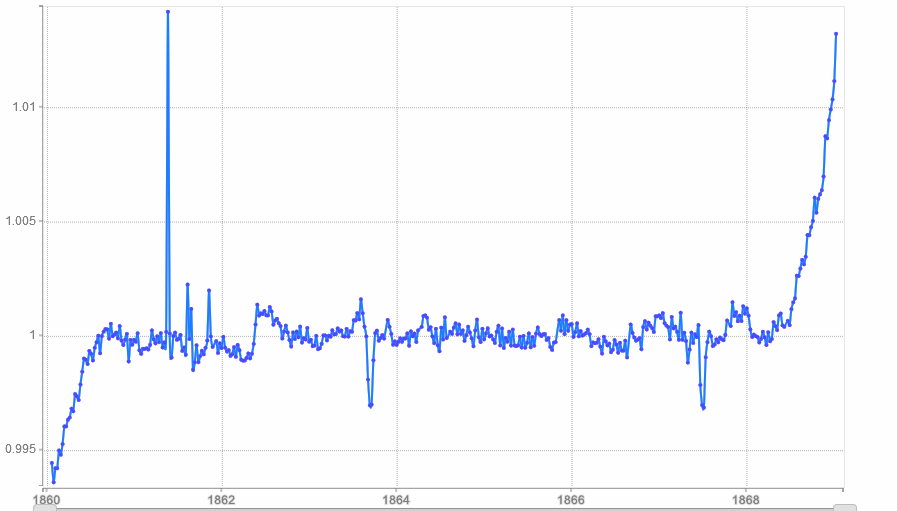
60019950 Possible Planet Transit in Kepler Two-Wheel Engineering Test Data

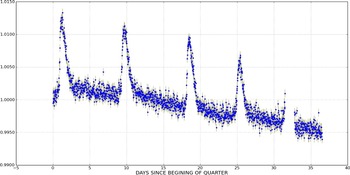
        Graph of Light Curve for 60019950 courtesy of Kian Jek

60019950, 354.9707, 1.98333, 14.8, cool_star
Kian Jek processed the data for this star that reveals two transits that may indicate a grazing planet transit.
Daryll LaCourse:
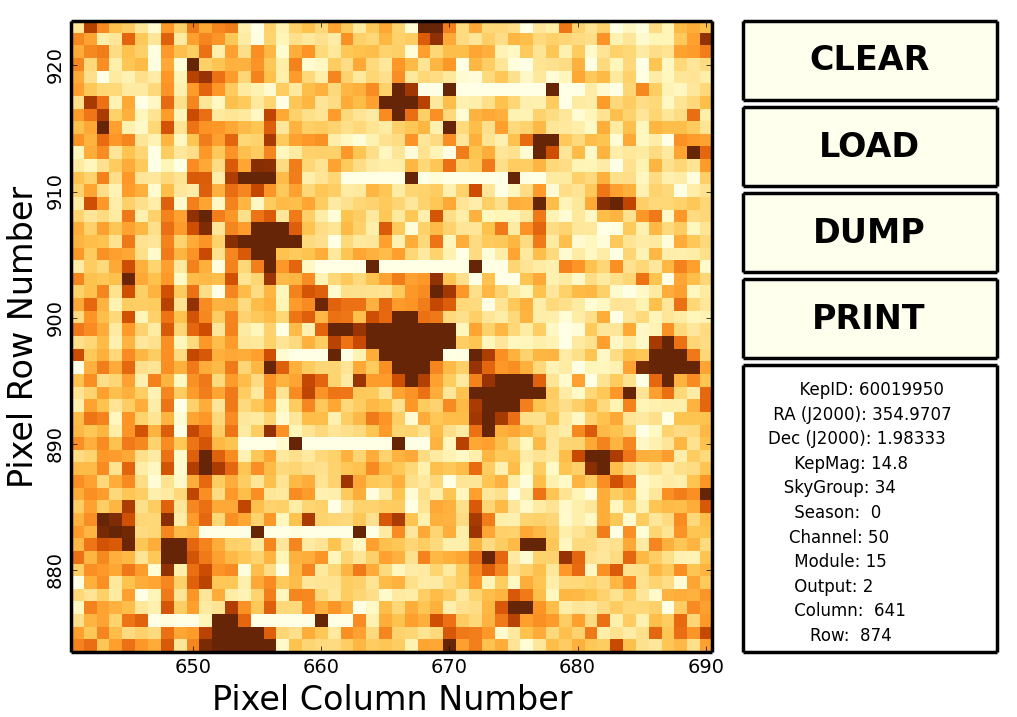
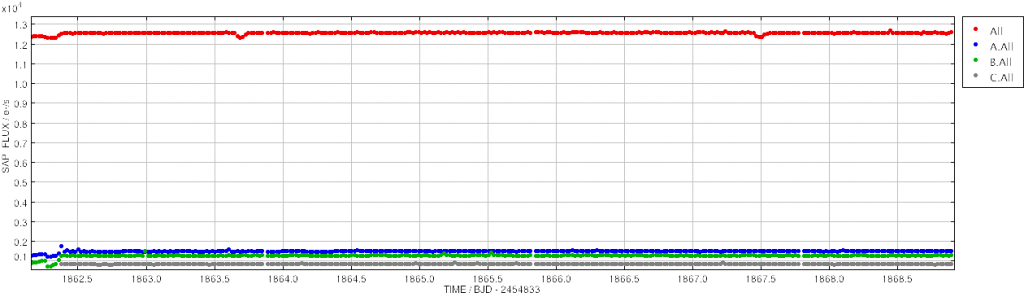
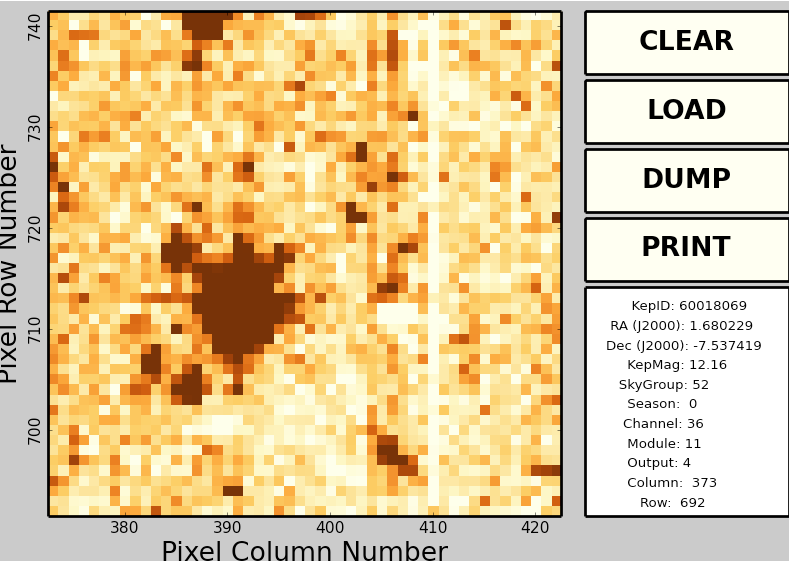
I took a few minutes to pull up the 60019950 field again. I've extracted light curves from the three neighbor sources at roughly 10, 7 and 4: o'clock, and I see no evidence for these transits/eclipses originating from any of those sources:


Daryll LaCourse:
If anyone wants a taste of what sort of light curves Campaign 0 may deliver, the massive TPFs for these engineering test targets arenow available. In order to extract light curves from them you will need to utilize PyKE (via Ureka bundle is probably the best method) or write your own software.
from the Kepler Blog (emphasis added):
TWO-WHEEL ENGINEERING TEST DATA ONLINE
MAR 25, 2014
9 days of two-wheel engineering data have been delivered to the MAST archive and are accessible to all interested users within the community. This data was collected between Feb 4-13, 2014, before Campaign 0, and points to a different region of sky to Campaign 0, RA = 359 deg, Dec = -2 deg. In future publications and presentations, we would be grateful if you referred to these data collectively as the "Two-wheel Concept Engineering Test". The motivation for delivering this test data is described below.

Campaign 0 is currently underway. Data collection began on Mar 10 and is expected to end on May 30. Campaign 0 is a full end-to-end shakedown test of two-wheel operations. The data collected from Campaign 0 will be processed through the existing Kepler pipeline only as far as the production of Target Pixel Files - small, calibrated and time-tagged images for each target. Further processing of the data, potentially through light curve creation, systematic error mitigation, transit searching and transit characterization is pending operational recommendations and financial decisions from the NASA Senior Review process. Therefore, for data collected during Campaign 0 and the first few potential future campaigns, the scientific community will be far more hands-on in the process of constructing the light curves required to deliver their science goals. Some of the approaches for light curve construction from Kepler Target Pixel Files have been incorporated into the existing PyKE software suite - Simple Aperture Photometry, PSF-fitted photometry and pixel-level Principal Component Analysis. While these Kepler tools will work out of the box for Campaign 0 data, users should note well that the larger spacecraft motion during data collection on two-wheels will mean that the best photometry solutions for Kepler will not necessarily be the best solutions in any future two-wheel operation. The community are encouraged to test the current solutions critically and develop alternatives when necessary. The Kepler Science Center will be turning its attention to these problems also, pending Senior Review endorsement, but the benefits of that effort will not be felt until deeper into the proposed mission.

Therefore to help the community in the endeavor of maximizing photometric quality and precision of a two-wheel mission we have delivered engineering data to the MAST archive. The Kepler spacecraft operated with fine-guidance, collecting data from 2,017 target masks. The properties and quality of the data therein is expected to be similar to those collected during Campaign 0 and provide an excellent opportunity for scientists to make an early and impactful start upon their investigations. Note also that the chances of there being undiscovered planet transits in this engineering set are high and the potential for other serendipitous science is great. To this end we have also provided lists of long cadence and short cadence targets with a brief description of why each was observed during the test. For those investigators eager to develop this test data scientifically and those investigators with the enthusiasm to develop new technical solutions for two-wheel photometry, we encourage you to dive wholeheartedly into this data set. The anonymous ftp address for data download is archive.stsci.edu and the data is archived in folder /pub/k2/tpf_eng. Alternatively there is a URL. A typical file size for one of these target pixel files is 26 MB. The Kepler Science Center will not support this engineering data with future reprocessings, deliveries or new products. However the Kepler Science Center will support questions through the helpdesk regarding this data set on a best-effort basis.

Visit Planet Hunters Talk for more information on analyzing the K2 Engineering test data.


Monday, May 5, 2014

KIC 8681125 Possible Unlisted Planet Candidate at Planet Hunters


Kepler Light Curve KIC 8681125 in  Q16 at Planet Hunters

Planet Hunters forum Talk member Kugelbitz flagged this light curve in Kepler Quarter 16 that was subsequently analyzed by veteran Talk members as a viable 5.24 RE planet candidate with two known transits in Q10 and Q16. 

Kian Jek:
The first new PC seen in a long time - and just goes to show there are still treasures hidden in the data set even almost a year after Kepler has stopped functioning and moved on to its next mission!
The problem with this target is that although it's situated near the center of the FOV, it lies at the extreme edge of the module, and it's only visible in two out of four of the CCD panels or channels. These correspond to the even quarters and so the odd quarter data are missing.

Because of these large data gaps, one can fit two possible periods to this PC, either 615d or 307.5d.


The two visible transits can be model-fitted to a 615d period transit exceptionally well (see the R2 statistic):


The transit can also be fitted to a 307d period, but this gave an anomalous a/R* of 187.7 vs 375; the latter value is more consistent with the stellar radius and orbital separation wrt period, so the 307d period can be ruled out.

The stellar radius appears to be slightly less than the MAST estimate, to give a Keplerian orbital parameter, approx. ~0.87x Rsol, so based on this, the planetary radius is ~5.24x RE. We will need ground-based follow-up observations to observe a third and confirming transit, this is possible now that we can construct an ephemeris, but it's still going to be challenging as this is a very faint Kp=15 star.
You can follow this planet on Planet Hunters forum Talk here.


Saturday, April 26, 2014

K2 Engineering Test Data: Light Curves and Analysis at Planet Hunters


Epic 600242244 showing transit using LcTools

Planet Hunters forum Talk member Daryll LaCourse (Nighthawk_black) has converted all the Kepler Two Engineering Test Data and it is now available online for analysis at Planet Hunters.

Daryll LaCourse:
" In early February an engineering test for two-wheel Kepler recorded 9 days of observations for ~2000 stars near Pisces. The original reduction pipeline is not suited to process this batch of data and will need to be overhauled (see this thread for the nitty gritty), but there is still some scientific value here and Martin Still has challenged the community to take a look. I think we should have a go at this! "
To that end I've extracted light curves from all of the available target pixel files using a brute force macro and piece of software available on the GO website called PyKE. The same 15x15 dimension pixel mask was applied on all targets; some have a secondary LC included that is slightly smaller. The complete output batch is 168mb worth of .FITS files and can be downloaded as a single .ZIP archive, or browsed individually.
.ZIP bundle Individual files

A grab bag of previously studied objects, including one confirmed planet hosting star called Wasp-28, were chosen for the target list and the catalog is broken up into the following sections:

EB
SC_target (short cadence)
Variable_Simbad
Multiple_Stars
Hot Stars
Cool Stars
Red Giants
GKM_dwarf
Eng_target

If you have recently joined the team or are a veteran but have previously only used the Classify and PH Talk interfaces, a 3rd party application will be required to look at these new stars. I would recommend downloading both of the following freeware utilities to experiment with:

TOPCAT by Mark Taylor: Stands for 'Tool for OPerations on Catalogues And Tables'. This program consists of a standalone Java file and for the purposes of these light curves it does not matter if you choose the Full or Lite version. Being that the former is only 26mb I would just grab that one. Should work on both Windows and Mac OSX.

LcTools by PlanetHunter Al Schmitt: This is a Windows based lightcurve viewer and signal processor developed for the Kepler project that Al has graciously updated for use with this data set. To install the software, please contact Al at aschmitt@comcast.net . You will notice that LcTools reduces FITs files to a smaller text format via 'LcGenerator'; I've already converted the bundle so it won't be necessary for everyone to do this. Once you have installed the product, just open this additional .ZIP file and follow the Readme.txt instructions.

A few things to consider when hunting around in these light curves:
  1. Significant artifacts exist in ~25% or more of these LCs; in some cases the target was not in the center of the mask or more commonly artifacts have corrupted the observations. The former I can go back and fix manually with PyKE, but the latter will require a true dynamic pipeline to address properly. Also note that there are four negative outlier data points in my test files (BJD 1861.91, 1863.87, 1865.83 and 1867.79), so you will need to zoom in past those if using TOPCAT. If using LcTools for browsing, those outliers have been culled away and won't be an issue.
  2. The extraction masks are large compared to legacy data and applied in a generic fashion, as a result I expect a significant number of LCs have flux from neighboring sources that were blended in. The total degree to which this is going on is tough for me to judge at the moment; some of the point sources here are as dim as 18 while others are as bright as 9 !
  3. Most if not all of the interesting variables in the first four sections of the catalog are already noted in literature and such information can usually be found with an RA / Dec crosscheck on handy databases like the VSX website,.
  4. While these '"Two-wheel Concept Engineering Test" files do have EPIC numbers assigned, you will not find them on MAST in the new EPIC catalog area.
If you want a particular star redone with a different mask size or a series of them, send me a PM and I will try to accommodate.
Have fun! "

You can visit this thread at Planet Hunters forum Talk and participate in the analysis here.

Wednesday, March 19, 2014

KIC 5871088 Possible Long Period Unlisted Saturn Size Planet

Planet transit in Q16 for KIC 5871088 at Planet Hunters

Planet Hunters forum Talk member Clue4fun4 flagged this transit drop in Kepler Quarter 16. It is a very long period planet that has shown up at the tail end of the Kepler data stream prior to the spacecraft going offline in 2013.

Comments by Kian Jek:
This is a very long duration transit that sneaked into the last days of Q16. Eyeballing it, the duration suggests a long period. The primary is a Type K subgiant.
Running a transit fit yields the following:


 The period is very long, from 4.4 to 7.7 yr. The planet is approximately the size of Saturn, at 8.11x RE, based on a stellar radius of 0.882x Sol.


You can follow this planet at Planet Hunters forum Talk page here.

Thursday, March 6, 2014

Japanese Science Team Confirms Planet Hunters Background Dwarf Nova for KIC 11412044

Planet Hunters Kepler Q5 light curve for KIC 11412044

Planet Hunters forum Talk member danasibogdan3 flagged this interesting light curve in Kepler Quarter Five that was later suspected by veteran members to be contaminated by a background  dwarf nova . We posted an article on the possible dwarf nova at this site on July 24, 2012. 

Japanese astronomers Taichi Kato and Yoji Osaki were alerted via our blog article:
"As mentioned in the acknowledgement of the paper, the paper
is based on your discovery of a new dwarf nova in the Kepler
field of KIC 11412044, which we have come to know from your
web page:
http://keplerlightcurves.blogspot.jp/2012/07/dwarf-novae-candidates-at-planet.html "
 They recently wrote a science paper that was accepted by Publications of the Astronomical Society of Japan (PASJ)  that you can view here.

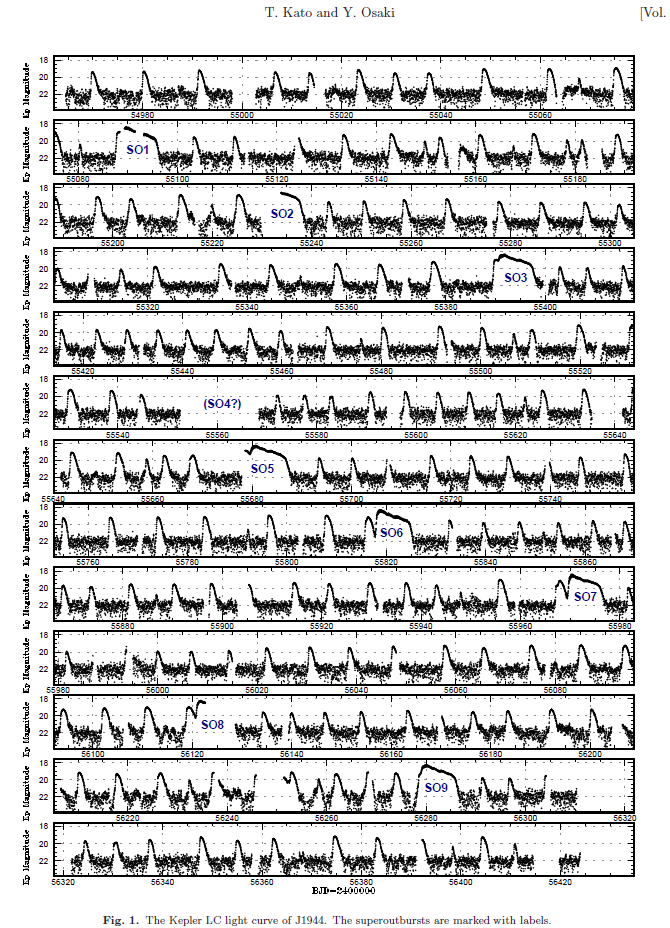
Light Curve for KIC 11412044 by Taichi Kato and Yoji Osaki
" The object is astrophysically very interesting as it has an extremely short orbital period and high outburst activity. "  
"We studied one of these background dwarf novae, the one in the field of KIC 11412044 (hereafter J1944). This object was discovered by the Planet Hunters group as a
background SU UMa-type dwarf nova of KIC 11412044, in which superoutbursts and frequent normal outbursts were recognized. 2 Since it was bright enough and it was
frequently included in the aperture mask of KIC 11412044, the outburst behavior can be immediately recognized in Kepler SAP FLUX light curve of KIC 11412044."
 "At this location, there is a GALEX (Martin et al. 2005) ultraviolet source GALEX J194419.33+491257.0 [NUV magnitude 21.3(3)] and we identified this source
as the UV counterpart of this dwarf nova (figure 3, Q16), confirming the suggestion in the Planet Hunters’ page. The superhump component and 0.0528 d component were
also confirmed at the location of this object (figure 3, Q14), and we consider that the 0.0528 d signal indeed comes from this dwarf nova."


Saturday, February 22, 2014

KIC 8016431 Possible Unlisted Planet Candidate

KIC 8016431 in Kepler Q7 at Planet Hunters

Planet Hunters forum Talk member Tesh90 flagged this possible unlisted planet candidate transit in the Kepler Q7 light curve. A second transit was identified near BJD 1420.2  along with transit analysis by Hans Martin (Zoo3hans).

Comments by Planet Hunters forum Talk member Kian Jek: 


Here is the TAP run:


The transit curve fit:


The transit depth is 933 ppm with a duration of 15.07 hr. In order to make the orbital parameters consistent with the stellar data at MAST, I find that I get a better fit if the stellar radius is adjusted up to 0.89x Sol instead of 0.621, and the stellar mass set to 0.95x Sol. This is more reasonable for a 5671K Teff, and makes this closer to a Sol-like star.

If so, then we get a 2.79x (+/- 0.21) RE planet, orbiting at 1.624 (+/- 0.21) AU from the primary. The Teq is approx. 184K.

You can follow the thread on this planet at Planet Hunters forum Talk thread here.

An Automated Search for Transiting Exocomets- HD 182952 (KIC 8027456)

A team of astronomers led by Grant M. Kennedy , discovered a potential third comet system in the Kepler prime field data of HD 182952 (KIC...